Thursday, August 30, 2012

Religious Virtues that Satan loves

Will-worship -- noble suffering, dying to self, submission rather than aiming in faith for the joy of life
legalism -- sticking to the letter of the law (as opposed to also trusting the spirit.)
repressed anger -- rather than speaking up against injustice
religious debates -- (it's okay to discuss one's faith but it's not men's wisdom that proves our religion: it's the power of God.)
Believing Everything is The Will of God -- This seems to be saying that God is omnipotent and sovereign, but it also blames God for stuff we or the devil or the world does.
Pity -- Pity will keep someone sick for ever.
Rationalism -- humans like to be praised for being good thinkers and for not being "emotional."
Denominationalism -- People like thinking they are on a good team.
Pious platitudes -- People think they are being wise and kindly when they say something holy-sounding. But they are often reinforcing some sentimental unthought-out unexplored bunch of hooey.

The reason he likes these virtues is because people think they are being good when they do them but sometimes are really falling into spiritual error and the devil's clutches.

Now, let's get into the seven deadly sins and the virtues.

The seven deadly sins are
gluttony -- enslavement to food (from overeating to only desiring a specific kind of food. A thin person who wants to eat only a specific kind of cracker or only a specific kind of beer is as much enslaved to gluttony as someone who overeats.)
sloth -- literal, intellectual, and spiritual laziness
lust -- enslavement to the desires of the flesh
anger/wrath -- enslavement to passion
envy -- enslavement to comparing one's self or one's earthly goods with others
pride -- enslavement to one's self
greed-- enslavement to the need to take everything the world has

The book of Proverbs definitely talks about these sins. Chapter 6:6-11 is good. The Book of Proverbs has 31 chapters. The best way to read it is to read the chapter for each day. On the 30th read chapter thirty, etc.

They are deadly because some sins are not sins unto death. But a deadly sin has the power to cut one's life short. Adultery, for instance, shortens life. (Did you know that less than 1% of people die while having sex but that of those who do die having sex, 87% or so were cheating on their spouse?) Gluttony also shortens life. As does sloth. And definitely pride. It goes before a fall. If someone becomes sick because of one of these sins, one may or may not pray for a full recovery because they have a sickness unto death caused by a deadly sin.

The Catholic church has a different interpretation of these sins..and I think (not sure) make them sins that even affect folks after their deaths. They have mortal (deadly) sins and then they have venial sins. The Catholic church also has it's list of virtues. Virtue can be something a person attains by working toward it. Or it can be something that grows in the person through the working of God.

The virtues depend on which list you're using. In the Bible James talks about a list of virtues, so does Paul, so does Peter in his "golden chain". 2 Peter 1:5 This leads to this which leads to that.

If you go to www.Biblegateway.com and do searches for these specific sins you can find a whole store of verses. They have a ton of Bible translations online. French, English, Czech, Spanish, etc.

The virtues are:
Temperance -- moderation to the point where an inner stillness prevents you from being pushed this way and that by the world, or by your own self
Faith -- the ability to hold on to God's truth in spite of what one's eyes or mind tempts one to believe.
Hope -- the ability to see a way through when there seems to be no way and to not despair. Hope also has a joy to it. This isn't just blindly trudging along but joyously advancing. It's combined with faith a lot. Because we have faith in God and in what God says we can hope joyfully.
Love or charity or Mercy -- kindness and understanding toward those who are weak, ignorant, or our enemies
Restraint or forbearance -- having the power to do a thing and yet to not do it because of the love one had for one's neighbor, the refusal to use one's power of speech, action, etc because God has a higher purpose than you merely succumbing to your desire to say or to do something.
Justice -- this is a toughie to describe.
Courage -- spiritual faith that does not falter when it is threatened.
Prudence -- the ability to think and weigh out a matter and to see the ramifications of one's choice instead of rushing headlong into trouble, also being aware that God has his own plans and our plans depend on him.

There are other virtues...virtues that are the opposite of the seven deadly sins, virtues from other traditions, etc. But for the moment, these are the ones worth pondering. -C

Saturday, August 18, 2012

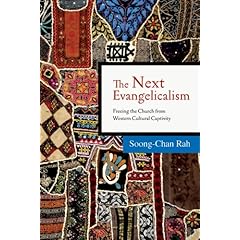
The Next Evangelism by Soong-chan Rah


The Next Evangelism: Freeing the Church from Western Cultural Captivity
by Soong-chan Rah

180 pages
IVP Books (May 2009)
English
ISBN-10: 0830833609
ISBN-13: 978-0830833603

I found these reviews

Review

"Soong-Chan Rah explores the impact of ethnic and geographic shifts on the present and future state of evangelicalism. He gives us fair warning that parts of his heartfelt book are 'intended to provoke,' and they will. But that doesn't stop his book from being timely, thoughtful and very rewarding." --Philip Jenkins, Edwin Erle Sparks Professor of Humanities, Pennsylvania State University, and author of The Next Christendom


Review
"In this manifesto for change, Soong-Chan Rah calls for the church to break free from limiting and exclusive paradigms and fully embrace the dramatic cultural diversity that is rapidly defining the twenty-first century in the United States. His powerfully persuasive pen engages and challenges the reader in ways that radically transform how church life is to be understood, shaped and lived. Everyone who cares about the Christian church in the United States needs to read The Next Evangelicalism. This book ignites hope for reconciliation in the world through the church."


Key endorsement on the back cover from Harvey Cox, Hollis Professor of Divinity at Harvard University:
"One of the most important changes now going on in America -- and indeed world -- religion is the profound transformation of evangelicalism, a movement which encompasses hundreds of millions of people. This book is the best and most balanced treatment of the subject now available. It is well researched, written and comprehensive."

Monday, August 13, 2012

The Tenses of Salvation

The Bible uses many tenses for Salvation

By Jesus stripes we were saved
We will be saved from the warth to come
We are being saved every day
We are saved and kept by God
and there are situations where we are in the position of being able to be saved.

It's not too complicated if we think of all the meanings of the word salvation and if we think of all we are required to do.

Our immortal souls are saved from hell and the wrath of God (a future occurrence.)
Our souls are being saved (in the present) from being tainted by this present evil world as we work out our own salvation through fear and trembling.
Our bodies were saved (before the foundations of the earth and when Jesus died on the cross) from disease by Jesus by whose stripes we were healed.
We are being saved (in the present) by the engrafted word of God which is able to save us but only if we abide in the word because this kind of salvation and sanctified life is given only to those who 1) seek first the kingdom of God and His righteousness...and 2) rest in the word 3) forgive, 4) water the word with thanksgiving 5) are loving (because faith works by love.)

If any of us are sick and have had the prayer of faith prayed over us, we are being saved by our faith in God. This means

Jesus tells us that A) we command the body to be healed and B) we believe that our prayer has been answered because JEsus said, "When you pray believe that you receive." Jesus also said, "Everyone that asks receives." St Paul said, "All the promises of God are yes and Amen in Christ through the father."

This means:
A) It's not about whether God answered our prayers. It's about whether we believe God has answered our prayers.

B) Believe you receive WHEN you pray.

This means:
We do not "Believe when you see the answer to your prayer" (Remember, "We walk by Faith, not by sight.")

Nor do we believe that God is "going to answer" our prayers. (Remember, Daniel's prayer was answered but Satan fought against him for 21 days.)

So we are saved in the spirit and God has given healing virtue in the spiritual realm but we are to ask God for wisdom, boldness, perseverance that will enable us to get the manifestation of what God has promised.

Let's say a person comes to Christ for the saving of his soul. He believes that he is a great sinner and that Jesus SAVED him from his sin and will continue to save him from this present evil world. He then asks God to forgive him for his sins and he forgives all those who had hurt him because he knows that God has said "forgive us our sins as we forgive others." He acknowledges that he cannot get to God by his own wisdom, by any mystical experience, by his own goodness. He decides to repent from his sins and from his own dead works. He asks Jesus to save him.

What does he think God is saving him from? Well, it all depends on what he has been taught.

When does he think he is saved? Well, it all depends on what he has been taught.

Suppose he has been told by the Christian who preached to him, "When you are saved, you will be saved from all your sins and the power of sin. You will be saved from all the disease you have." It often happens that miracles occur at the point of his accepting of Christ because he was taught that Jesus saves to the uttermost. His idea of salvation is pretty large. But most people have faith for things they don't see rather than for things they do see. Remember, Jesus said, "Which is easier to say? Your sins are forgiven you? OR Take up your bed and walk?" It's easier to say "Jesus has saved your soul." Because the Christian doesn't have to put his faith on the line by actually proving anything visible. But in places where people have no prejudice against the full gospel, it's just as easy to tell the new convert "be healed" as to say "be saved." (Of course in the Bible the word for salvation means: healed, saved from sickness, saved from death, saved from hell, saved from demons.

The new convert in the west is usually told one of two things:

One of the typical thing he is told in the west: "Jesus saves your soul and has saved you from sin. This means Jesus has saved a person from the power of sin. Your spirit is now empowered to not sin. Sin has no more power over you. When you fight against sin's temptations, you will win because greater is God against you than he than is in the world."

Or the new convert is told: "Jesus saves your soul from sin. Now, go and sin no more." This is also true but the new convert is now made to feel that he is fighting sin all by his lonesome self. He must now go out into the world with his own will with no spiritual help.

Either way, let's say the new convert comes to the Christian who converted him three days later and says, "I prayed the prayer of faith but I don't feel saved. I don't feel good. I don't feel this extra love of God or this love of holiness I'm supposed to feel. I still don't like the idea of reading my Bible and I still want to smoke weed, drink, and hang out with the ho's down the block." The Christian who helped to convert him is likely to say, "Some people don't feel saved. Some do. You aren't supposed to go on how you feel. Just trust that you are. Believe that God HAS saved you and He IS saving you every day from the power of sin and that you WILL BE saved from death, the world, and the flesh. Just trust the word of God and the spirit of God and the blood of Jesus to save you....Oh yeah, and try to read your Bible anyway. Because you really need to read the word for the word to change you. The word is active powerful and transforming."

The same is true of getting a miracle for healing. We are prayed for but we say, "The Bible says, 'By Jesus stripes I am healed' but I don't feel healed." The answer is: "The Bible doesn't say you will "feel" healed. It only says you are healed. Walk by faith in the word of God and the blood of Jesus and the power of the holy spirit. You were SAVED and HEALED. The word is working within you TO SAVE AND TO HEAL you...even now! Only receive the healing as already given and you will SEE it. So, continue taking your spiritual medicine (the word of God) and the medicine your doctor has told you to take. Ask Wisdom of God about the seed and root of the illness. But think of each prayer as the moving of a mountain. When the mountain is big and faith is small, God has provided that the healing will come as the growing of a plant. First the blade, then the full plant, then the flower. So know that you are moving the mountain. The mountain may not be in the sea but it is NEAR the sea. Only believe that you have already received your healing from God." Jesus said, "Did I not say to you: If you will believe, you will see the salvation of the lord?"

Saturday, August 04, 2012

Verses that touched me this morning

Pharoah's daughter went down to the river to bathe -- Exodus 2:5
Wow!!! Think of that. A small little decision like that is direction and guidance from God....PLUS God's timing. And deliverance is made for God's people. If she had bathed elsewhere or earlier or later.... what would have happened to Moses?

The chastisement of our peace was upon him. -- Isaiah 53
Mental healing is in the redemption. So many illnesses come from not being peaceful. There are so many emotional wounds in the world. We often think of Jesus as the great physician of our bodies but he was despised and rejected of men so that our spirits can be healed.

Whatever things are lovely, true, joyous, of good report. -- Phillipians
Here I was praying to God for manifestation of my healing... but in my mind I imagine, "well, will I be able to go on an airplane? No, I imagine myself getting very tired for the entire trip." My imagination needs to be restored and trained to see good things.

And last but not least a God wink.

Backstory: when my son was just a year old I was sitting on the bed when I heard quite loudly the holy spirit say "Rest." I wasn't resting. I got up and went to the other side of my bedroom to pick up my son. He had taken four letter cubes from the pile of alphabet blocks and had spelled out in perfect order R E S T.
I was amazed...and yet... I didn't really take the advice. I should have. Maybe learning to rest back then would have spared me this fibromyalgia.

This morning I was lying in bed and the same son -- now 21-- sat beside me. I kept telling myself to rest and to stay in bed until 9:30 or 10:30 just to recoup from another night of sleeplessness. I told myself to do that every morning. But theer I was...about to get up when older son decides to come and lie down beside me on the bed. I was reading a devotional so I said to him, "Pick any number from 1 to 472." He said, 372. I turned to the page and this was the verse it was talking about: "God blessed the sabbath day because he rested." Then the devotional went on to talk about the value of resting.

This kinda stuff happens to Christians all the time. So what does one say when atheists who have never experienced these kind of things tell us that God doesn't exist?

Saturday, July 14, 2012

What God says we have versus what we believe we have

I John 2:12-14

Okay, this is how the verse reads:

12I write to you, dear children,
because your sins have been forgiven on account of his name.
13I write to you, fathers,
because you have known him who is from the beginning.
I write to you, young men,
because you have overcome the evil one.
I write to you, dear children,
because you have known the Father.
14I write to you, fathers,
because you have known him who is from the beginning.
I write to you, young men,
because you are strong,
and the word of God lives in you,
and you have overcome the evil one

As Christians we all agree with verse 12. Those of us who have been in church all our lives have been trained from birth to believe that God has forgiven us. Okay, some of us still think that God is ready to get mad at us over every little thing -- perhaps because we have been in churches where the minister majors on sin-- but for the most part we all accept the idea that Jesus saved us from sin.

Where we part from God is ...well, pretty much everything else.

Verses 13 and 14 tell us what we have and what we know. According to God. But we don't believe we know the Father. We don't really believe we have overcome the evil one. We don't really believe the word of God is living and active and powerful in us. Remember when Thomas (or was it Philip?) said to Jesus, "Show us the way to the Father!" and Jesus said to him, "You know the way." Philip said, "uh...no! I don't know the way." There he was disagreeing with Jesus about what Jesus told him about the truth. We Christians are always doing that.

We are told in the Bible that we have the mind of Christ. That means God's love is within us, God's power over sin is within us. Very few of us believe that.

We are told in the Bible that we can heal the sick, raise the dead, cleanse the leper. We don't really have faith for that. Not really.

We are told in the Bible that we all have been given the like measure of faith. The same talent given to all, that we can build on if we choose to walk out on faith. We don't believe that. We believe that God has given some people great faith and other people little faith. Not true. In the Bible the difference between great faith and little faith is the fact that some folks have a deeper understanding of what they have and the power of faith. We all have the same measure of faith. We just have to use that servant instead of letting the servant sit around doing nothing. Come on, when was the last time you spoke to a mountain? How many of us have planted the word and trusted that it is growing whether or not we see the blade or not?

The Lord tells us "The Lord is my shepherd; I shall not want."
The Lord tells us "By Jesus' stripes we were healed."
Why do we lack, then? Why are we unhealed?
Because we do not receive with meekness the engrafted word that is able to save.
Because we do not enter into God's rest and trust that the active living word of God is working mightily in us. Hey, we have had mega-religious teaching that tells us that God makes us suffer for his glory, that God wants us to strive and strive before we receive the answer to a prayer. But that's not what the Bible says. The Bible says God answers speedily. The Bible says the seed grows secretly at first. The Bible says just as something demonic fought against Daniel's prayer so sometimes the devil fights against the fulfillment of the prayer. Most of the problem with unanswered prayer has very little to do with God's willingness. God is loving and willing. God is a good God, not a tyrant. The problem is with us receiving and truly doing what the Bible tells us to do to pull that prayer into the natural. Trust me: I know whereof I speak. I'm a minister's grandkid and it took me years to get past some traditional theology and see what the Bible is actually saying.

Let God be true and every man a liar. This means...the lies in our own mind which come against the truth as revealed in the Bible.
Hey, I'll admit that I'm not sold on the idea that every mountain I talk to is gonna go. But I know it should, I know it will...if I keep up the good fight of faith.

Hubby had a funny dream which shows God's wit. He dreamt that a great minister whom he highly respects called him and said, "Come with me and help me cast this demon out." My hubby was perplexed that a minister so great would be asking him for help. But the dream is right and totally true. We all are equal in God's eyes. No one is more powerful than another. We tend to put certain people into categories as powerful Christians but the Lord has said, "Would that all the Lord's people were prophets!"

There's an old saying about "It's hard to go building your house in a storm." Very true. When you have no house and a storm comes, you run to your neighbor's house and say 'My house is shoddy. I can't stay in it now with this terrible downpour. Can I stay here?' So we run to the prayers of those who have learned how to use their prayers for others. But we can't keep doing that. We have to learn how to build up our own faith. So that we can move our own moutains and help other folks who might need our prayers.

In the epistle of James, God tells us that when we look into the Bible we look into a mirror and see who we really are. When we look at the world, the world tells us what we are. Therefore we must take heed what we hear and accept what God tells us we have received. In the book of Hebrews we are told that the physical world is built on the intangible word of God. Faith brings spiritual things into tangible reality physical form. But how can we believe God's report if we use some of man's tradition's to blind us to what it is really saying. Jesus said the traditions of man have made the word of God to none effect. So we must read the word, trusting God to speak the truth in our hearts and to remove the false theologies from our spirits, minds, and hearts.

Read the Word. Believe what it says. Ask God to enlighten you and to help you perceive the truth. Cast down your imaginations...and trust what God said.

Thursday, July 12, 2012

Fear not their fear

Say ye not, A confederacy, to all them to whom this people shall say, A confederacy; neither fear ye their fear, nor be afraid.
Isaiah 8:11-13

Jesus tells us over and over that in the last days there will be all kinds of deception and lies. He also tells to be careful how we hear and to keep our eyes on the light of his word.

Okay, not that I'm anti-hospital and anti-AMA but I DO get annoyed when they get into prophetic mode.

I've never been one to jump on any bandwagon. Took me years to get a CD and a computer. And I still don't have a microwave. (Because they kill all the nutrition in food) but back in the day I remember a New Yorker article warning about the dangers of increased cancer risks in those who had taken meds to lower cholesterol. That was 20 or so years ago. And still the media and doctors tell people they must lower their cholesterol because high cholesterol is a "disease."
Okay, high cholesterol may have been linked with heart disease in some people, but it doesn't mean high cholesterol is the cause of their heart disease. It might just be a corollary to the heart disease...and something else might be behind both the heart disease and the high cholesterol. Like hemcysteine. Or remember the days when they thought ulcers were caused by stomach acids then they now realize it's caused by bacteria. And the stomach acids are now corollary.

Anyway check out:
In the current study the ideal LDL cholesterol level was 126. The researchers were able to identify a bell shaped curve, in terms of a departure in either direction from this ideal number. LDL over 146 or less than 107 was associated with 33% increased risk of cancer. LDL over 164 of less than 87 was associated with a 50% increased risk. The risk keeps getting worse the higher or lower the number progresses away from the ideal of 126. LDL in the range of 108 - 145 had no statistically significant cancer risk, although being in the center of this range is clearly best.

The rest of this article can be found at:
http://www.newswithviews.com/

While you're at it, check out this article on mammograms versus thermograms.

The surprising truth about breast checks

The upshot of this post: don't fear medical prophecies. The medical world is ruled by big pharmaceuticals who want to make money and by docs who don't really know as much as they should...and by folks who make wrong conclusions, scare folks, then fifty years later change their minds. Remember, these were the folks who used to do lobotomies. Medicine keeps changing and reversing itself. God never changes. Seek his wisdom. And let us not accept the seed of Satan's deception. To accept the seed of fear is to plant it in one's heart. And Jesus tells us that out of the heart are the issues of life. Accept a seed of fear, believe it and plant it, water it everyday and soon it will bear fruit. We don't want that. We must trust in the Lord with all our heart and lean not to men's understanding. Or at least we should take what they say with a heavy grain of salt.

Been sleeping. Drinking my water and getting my son. Ah vitamin D!

Sunday, July 08, 2012

Ask Seek Knock: Part 1: Ask

"Ask, and you shall receive. Seek, and you shall find. Knock, and the door shall be opened to you." Matt 7:7

These encouraging words of our Lord not only help us to persevere in prayer, they help to make our minds like Christ's. True, we know that we are being conformed to Christ and His mind is daily being formed in us. But we often forget that we are beings who are made for Eternity, and we will not be able to receive a full reward if we enter into our Real Country with personalities and character traits more suited to this land we presently sojourn in.

In addition to receiving, finding, and having a door opened, we also are learning to worship God in spirit and in truth. Jesus encourages us to Ask, Seek, and Knock. If we follow this command, we will achieve the fruits of love, faith, and hope. As St Paul tells us these are the three things that endure.

Asking and Receiving
When we ask, we are trusting that God hears us. We are consciously believing that Jesus loves us and has heard our prayers. But asking is not enough. After we ask, we must train our minds to look expectantly for the answered prayer. The saints in Heaven were people who learned how to see the invisible. They saw heaven before they got there. They saw the visible result of prayer when there was only God's Scriptural word --the invisible seed hidden in their heart. Like them, we must learn to have a confident expectation that the good seed will flower and produce fruit. We must learn to believe in the seed growing secretly. The Bible tells us that the wind blows where it wills. (John 3:8) The Scripture tells us that God is the Husbandman who gives seed to the sower, who sends rain and sunshine, who prunes and fertilizes the plant, and who gives the increase. But we also have our part. We are to water the word, watching in prayer with thanksgiving. (Col 4:2) When we plant earthly seeds in the springtime, we believe that there is power in the seed to grow. Although we don't see the seed because the dirt covers it, we know the seed exists. Earthly farmers use earthly methods to reap their harvests. We are spiritual seed-planters. When we ask God for something, we are using God's word to plant invisible seed. God's word is active and powerful (Heb 4:12) and it has life in itself just as earthly seeds have life in themselves. God's word accomplishes what God sends it out to do. BUT this spiritual seed must be watered spiritually. Our prayers must be planted, watered, weeded, and reaped spiritually. How do we do this? We water the seed by praising God and believing that the prayer has been granted, even when we do not see any signs of the result of our prayer. That's how we "receive." The Word of God is an imperishable seed. It will not die. The calling and grace of God are without repentance. God doesn't take back what He gives. But we must be careful not to neglect the gifts that God has given us. If the word of God will profit us, we must mix it with our faith. We need to water the seed by faith. St Paul tells us that we water the word by giving thanks for what God has done. Jesus said, "When you pray, believe that you have received and you will have." St Paul says, "In due time, we will reap if we faint not." When we praise God in faith for something we have not yet seen with our human eyes, we are "believing that we have received." We are not fainting; instead we are participating in the reaping of the precious promises of God. We don't know when or how, but in "due time" -- the harvest time-- the seed will grow. We walk by faith and enter God's court with praise, trusting that He has already answered our prayer. This means that we don't begin our prayers with doubt, but with a faith that God has already answered our prayers. Oftentimes we begin to believe that God has heard our prayer when we start seeing an answer to our prayers. The little sprouts and blade begin to rise and then we start praising God. That's well and good, but we are to walk by faith in God's word, not by what we see. Blessed are those who have not seen and yet have believed. Therefore, we must live expecting that something good is happening even now. In all things and in all situations, we must rejoice -- regardless of what our human eyes see-- because the eyes and heart of faith know that God is in charge and that He cares for us.


But why do we water the seed. What is the real reason? How can we continue watering seed when we have not seen the blade, the stalk, the full flower? Because we know the personality and character of God. We love Him because He first loved us. As we give thanks and walk in love and wonder at His goodness, we train our souls to trust in God's love, power and providence.

Wednesday, July 04, 2012

The lovely Corinthian Church

When I think of what new testament church I'd like to hang out it, I think I would have loved the Corinthian Church. Or the Philipian Church.

But back to the Corinithian Church.

They had tons of spiritual gifts and they were constantly confusing earthly mysticism, earthly demonic stuff, with God's way of working with his spirit. Because the Dionysian cult in the city went all ecstatic in their spirituality they believed God's spirit would "take them over too." Paul had to remind them that things should be done decently and in order and the spirit of the prophet was subject to the prophet. (Yes, Juanita Bynum, please note: the spirit isn't taking you over. You've got to learn when to quit and not go overboard.)

The Corinthian Church also went overboard with their acceptance of sinful folks. A little gnosticism, a little pride, a heck of a lot of 'turning the grace of God into lasciviousness'

But this is the bunch that Paul said wasn't short of any spiritual gift, and that he encouraged to seek more spiritual gifts.

God's gifts are just that: God's gifts. They aren't the fruits of the spirit. Some very immature people are given God's gifts. Some very sinful people too. So, when we look at folks like Ted Haggard, Todd Bentley, and many great healers or folks who have shown that God's great gifts is working within them...we should not judge too harshly. God uses all Christians and gives His gifts to all people. And some folks know how to use the law of faith. It doesn't mean we should continue sinning, but we should be merciful to folks because we are sinners also, are we not? We're still trying to be full of God's holiness but it is the father's good pleasure to give us the kingdom -- they're gifts from a loving father, after all.

And interestingly, Paul writes to the Corinthian church saying, "I can't give you meat. I can only give you milk." So that's intense. Corinthians, as deep as it sounds, is only spiritual milk. There is no depth or meat in the Corinthian Church letters. Yet, we contemporary Christians have not even attained to some of the wisdom written there. Sad, uh?

The ideal of the lost


I was lying in bed when I heard this phrase in my spirit:
The ideal of the lost

I didn't know what it meant. Still don't. But It so reminded me of something Oswald Chambers would say. I don't know if it connects to my personal life alone, or to the USA because this is July 4th, or to Christendom.

We all have ideals of lost things, don't we? Lost Eden, versus The reality of the regained Dominion, maybe. Lost ideal of ourselves and the way we were. Who knows?
was really strong in my spirit though

I thought about how Oswald would do it, the way he does his books and came up with the following ..to balance out the entire concept and meditation.
The ideal of the lost -- the Ideal of what America supposedly wasthe ideal of our lost health, our lost youth, the ideal of what Man lost in Eden and lost, the ideal of what True Christianity was intended to be... True or False Nostalgia?

the reality of the lost --  

the ideal of the found, 

the reality of the found.

I still don't know what it all means...but pondering.

There is often an idealization of something lost, isn't it? Our old selves before the illness, the old computer game which we loved and used to play but now windows doesn't work with it. There is also the Great-Might-have been, the stuff we thought we should have gotten in this life. For American and Americans, there is the great idea of how wonderfully noble and pure the USA was -- the city set on a hill and all that. For Christianity, there is the idea of what Christ meant his church to be...and what happened after philosophy, religion, and culture messed with it. The reality of the lost is another thing. Was that card game really so good? Was the old neighborhood really that good? Was I -- even in my healthiness and beauty-- really as healthy nd beautiful as all that? Sometimes one is sick but it doesn't show. Or the old lost friend...maybe they weren't as perfect as all that. Or American history, the reality was there were a heck of a lot of white guys who had power and the Native Americans were being deprived. As for Christianity, the good old days were full of persecutions from outside and schisms from within. So even in its heyday, it was still struggling to do what Jesus told them. Or we wouldn't have all those letters from the apostles telling folks to get their act together. The Ideal of the found is pretty much that "now tht we have it" all shall be well. The new found friend, the new found weight loss, the new found house, the new found president, the new found government. And the reality of the found. The found in reality is also something one has to keep working for. Just because one was lost and now am found doesn't mean the work stops. the new found law (did the civil rights act really help Blacks as much as folks thought it did? Will gay marriage really be as great as gay folks think it will be?Thinking, thinking...YAY...this'll be my post for today


This is Rose-Marie's take:


such a good word, carol. i was thinking of something similar this morning. we are so afraid to lose
and be lost and yet we must be. it is our goal to be lost to ourselves so that wemight be found in him.
that is not a truism that we just say that is crazy religion that makes no sense. it is a fundamentla principle
i think, but we hestitate to truly believe it because it feels weird.  
i read this book about memory....cant remember name but it was talking about how our memory
is not accurate and we idealize things, (probably making them into somewhat of an idol)--my addition.
all of what you say is true, the good old days werent as good as we thought they were but somewhere,
in some of all this, is a line of sweetness of all that is good and true, and maybe that is what we long for.
not in platonian terms but in our longing for God who produces good from the horrible wrecked and beauty
from ashes.
i live in massachusetts and cringe when people talk about how christian we were back then.
the whole massachusetts bay colony was built on the idea of being a "city on a hill"  but they were
notoriously pharisaical and intolerant in a bad way. and they had known what it was to escape persecution
...we never had the "christian" america that we thought we did. not to diminish what we did have--for we
did have a lot!


This is Debra's take on it:

Interesting and I shall ponder. Being July 4 of course one is put in mind of the ideals our nation started with, and how so many of those are lost. Is our civilization failing, or merely evolving? Are we headed to a dark age, or merely shifting in to the next thing?

If... continuing in the metaphor... our nation is lost, then what does that say about the ideals? Are they lost as well? (No). And what is to be done with those ideals then?

Same for Christianity. As you know, the reason I left the church had nothing to do with Christ or Christ Consciousness. Rather the extreme lack of it in the institutions to which I was witness. Obviously Christ lives on and I found Him again through a wee Hindu man named Paramahansa Yogananda.

Or maybe personally to either of us. I have been snickering to myself as recent years sure have ripped the material away from me. And yet this has been a true blessing to my personal development. I'm pretty pared down now, and yet this is the best place I've been as an adult I believe. No money, no property, and age moving in fast, yet I'm smarter and more real now. I imagine the same for you as well.

This is a great suggestion for thought today and I thank your guides or whoever whispered it in your ear. And thank you for sharing.

Is Lost really lost? Or is Lost really Found? 

This may require a glass of tequila.


So I have much to ponder.


Saturday, June 30, 2012

Verse that jumped out to me this morning: Boldness

1 Timothy 3:13 For they that have used the office of a deacon well purchase to themselves a good degree, and great boldness in the faith which is in Christ Jesus.
1 Timothy 3:12-14

Wow!!! So...faithfulness in being a deacon brings the spiritual gift of boldness!!!!! Wow!!! Is that why Stephen was so bold in preaching!

Is that why we see so few manifestations of spiritual gifts nowadays?

The Bible teaches us in many ways how to increase in boldness in faith and in witnessing. It says faith comes by hearing. (Which is good. It's not as if one can never get better faith. We are told that faith cometh. So we can increase our faith by hearing.)

But here it says we can also get the spiritual gift of boldness by doing the physical human earthly thing of being good deacons.

Ecclesiastes 8:1 Who is as the wise man? and who knoweth the interpretation of a thing? a man's wisdom maketh his face to shine, and the boldness of his face shall be changed.

Acts 4:13 Now when they saw the boldness of Peter and John, and perceived that they were unlearned and ignorant men, they marvelled; and they took knowledge of them, that they had been with Jesus.

Acts 4:29 And now, Lord, behold their threatenings: and grant unto thy servants, that with all boldness they may speak thy word,

Philippians 1:20 According to my earnest expectation and my hope, that in nothing I shall be ashamed, but that with all boldness, as always, so now also Christ shall be magnified in my body, whether it be by life, or by death.

Having therefore, brethren, boldness to enter into the holiest by the blood of Jesus,
Hebrews 10:18-20

1 John 4:17 Herein is our love made perfect, that we may have boldness in the day of judgment: because as he is, so are we in this world.

Thursday, June 21, 2012

Loving Philip -- the non-prejudiced disciple

One of my favorite disciples is Philip. I just love this guy. I mean, Peter even had racial issues AFTER he received the holy spirit, after he had the vision of the sheet dropping down to heaven. His prejudice against gentiles and non-Jews is soooo ingrained that even in chapter seven of ACTS he buckles when some of the Jewish disciples like James saw him eating with gentile believers. Once a wimpy reed always a wimpy reed even if Jesus named him Rock it just didn't take.

But Philip, sweet wonderful Philip is totally different. During Jesus' disciple, Philip brought some Greek believers to speak to him. Philip also was the one who spoke to the eunuch of the Candace of Egypt. But especially, Philip was wonderful to the Samaritans.

The Samaritans were a group of people whom the Jews rejected. Basically what happened was that the Jews were taken out of their land by the conquering folks. 2 Kings 17. A few of them remained and then the conquering folks put strangers --non-Jews-- in the Jesus land to repopulate the land. The Jewish religion there and the Jewish people there got all mixed up. When the Jews returned to the land t0 build the temple, the Samaritans offered to help to build the temple but the returning Jews rejected them because they were mixed "Get your unholy hands off our temple."

Incidentally, beginning with Abraham the Jews had a history of rejecting folks they just didn't consider holy enough. Both Abraham and Isaac didn't believe that the gentiles they encountered were even decent enough to acknowledge God or marriage. It's the problem with a spiritual vision of being a great people, I think. And folks in the United States have it too. Heck, Joseph (Jacob's son) had the same problem. If you have a great vision, you just belittle everyone else around you. And Jacob's sons killed Shechem (the prince who got involved with Dinah) because they didn't think he was good enough.

Anyways, the Samaritans got rejected and built their own temple to God since the Jews didn't want to include them as God's people. But Jesus accepted the Samaritans.

Andn so did Philip. He was so accepting that he even had Simon "Magus" in his ranks and accepted him before Peter gave Simon a talking to. So whenever I think of Philip, I think what an open-minded lover of different cultures he was. It's been said by some that the book of ACTS was written by the evangelist Luke in order to make Jewish disciples see that God was doing mighty acts through Paul among the gentiles. Hey, we know Philip didn't need the book of ACTS to tell him that God loved the gentiles -- and even the hated Samaritans. He had the loving knowledge in him all along.

Tuesday, June 19, 2012

Critiquing and the Curse of Insightfulness

Ever had a situation occur where you're critiquing someone's story or reviewing a novel and you get this really weird vibe?

I'm not talking about a vibe the writer intentionally put into the story. Something about the writer's own issues. I'm talking about the old phrase: "A bad novel tells about its author." Heck, even a great story can tell too much about its author.

Sometimes you -- the critiquer-- sense that something is not quite right. Others may not sense it -- which makes you look like a total nut-case.

It happens in various ways.

Consider a short story written by a friend of mine. I will only describe this friend as "light-skinned."
In her story, she wrote about how the way her neighborhood changed. Apparently, all was well in this great black and white integrated neighborhood, then some dark-skinned Caribbeans (or might have been Jamaicans) came and ruined the neighborhoods, getting their dark hands -- like monkeys-- into everything. Okay, so I said, "I understand this story is written from the main character's POV but this doesn't work for me. Not that I have a problem with a prejudice protagonist. But there is a certain passion and anger here that --yes, although the MC is angry-- feels odd to me."


The author's response: "It's the MC's pov."


Well, whatever... But I will state that this type of character shows up way too much in this writer's work.


Then there is the black Christian writer friend -- dark-skinned like me-- whose non-fiction piece was about how bad blacks were ruining it for good blacks...and whose EVERY novel has a black woman with green eyes. If this woman has written a story about a tragic mulatto once, she has written it a zillion times. Oh, she doesn't come out and say "tragic mulatto" but she always has ignorant dark-skinned black characters set up against good green-eyed black character. Is this self-loathing or what?


Okay, so I'm talking about a certain consistency. That's because I don't want to be wrong or unfair. Why assume a guy is bigoted against religious folks or Jewish folks or Blacks or Asians or Mexicans only because of one story? 

But sometimes....ONE story is often what one needs. Because when one challenges some aspect of the story, the writer's reaction is a bit over-the-top. This is because the story is too close to the author's heart. And when they challenge you on why you have challenged them, it feels like they're trying to convince everyone of the nobility of their character's choice and behavior when in fact what is going on is quite atrocious -- the way the story is written.  


The thing is... I can deal with any kind of plot in a story. Seriously. I have a terrible honesty. A true witness delivers souls, as the Bible says. So I tend to go all honest in my stories. If someone comes up to me and says, "this or that about this story seems to be about your situation," I will probably say yes. Or if someone thinks I've created a character in a "bad light" and they therefore feel they cannot like a particular character, I will probably say, "Yes, I've created her in a bad light purposely. I am being honest. The character is like me. If you don't like her, that's too bad. Do you judge everyone based on their horrible character traits? Are you so perfect?" Yeah, I'd probably say that.


But when there is something terribly dishonest and veiled in the way the narrator has presented certain characters or situations to the reader, well, I have to scream foul, because something feels inherently dishonest.. Yep, dishonest. Because there is something vaguely self-serving and unreliable about the POV, about the narration, about the rationalizations, about the whole set-up. Why can't the character simply come out and say or do the wrong thing? Why must the character be seen as right (and the story has to go through a zillion hoops to prove the rightness of the character)? Why can't the character simply be someone who is wrong, has made the wrong choice, and the author is gonna let it stand, bare before us with no rationalizations? Because the write is not being honest....and this is the hardest story to critique because you're up against a writer who either knows she is wrong (but will defend it to the death) or who believes she (oops, her character) is right and will close her eyes to any kind of truth you throw at her?


Obviously stories like these are nestled high on a point in the writers' own life and it almost makes the critiquer wonder if the writer or someone she knows has done this kind of thing and rationalized it away in a similar way. It screams of a writer who is trying to pretend that there is not an issue when there is and unfortunately those stories are the most aggravating to read...


The story as it is presented will give readers two different reactions. Some might see the story the way the reader wants everyone to see it (I so will not say what I want to say about readers who encourage writers in their delusions) and some will really dislike the main character and wonder about the author. The scary thing is that a few years after the story is published, if the writer is sane and has matured....the writer will re-read the story, and they will understand exactly what the critiquer meant to say and will be surprised at their own dishonesty. (I won't even talk about the writers who didn't grow or mature.) By then, of course, the writer will have lost a friend because A) the writer didn't want to acknowledge she had allowed her neuroses to create a false story or B) the critiquer will have lost all patience with the writers' dishonesty. The curse of insightfulness alas is that the critiquer often never quite realizes she is about to step into the mire...so it's difficult to stop one's self until after the writer has thrown a hissy fit and gone into full-blown victim mode.. 


Just saying. 

Saturday, June 16, 2012

Fasting -- how i hate it

Well, it's been eight days in a row of absolutely no sleep. What an annoyance! Sometimes I manage to get an hour or even four hours. But this stretch!!! Not good. Especially when you have to get up in the morning to take care of a non-verbal child labelled autistic who seems to have been in pain for every day of his life...and who also sometimes doesn't sleep. Am in a great deal of pain at present, plus tired, and antzy.

Will be reviewing my ebuddy's book So Many ways to Sleep Badly. He also has fibromyalgia but he manages to get around. Gonna be interesting, reviewing his novel. Me a born-againer and he a transgendered person in the sex industry. But ever since he accepted my essay in the collection, Nobody Passes, I've had a real love for him. That sleeplessness bond. Plus the sex abuse bond.

In Wind Follower, I gave Satha my sleeplessness but I didn't follow through on it. Cause I didn't want it to take over the novel. Just waiting to see what Mattilda does with sleeplessness in his novel.

Church was fun yesterday. One of those fiestas we all love. Which reminds me:

What would have happened to me, Lord, if it weren't for your grace and your love?


Made a really intense and good catch in my novel a couple of days ago. Okay, I am all too well aware that my stories and novels generally have folks in interracial relationships. And I am aware that I tend to have light skin men doing the conquerinr and dark-skinned women in the women in distress mode. But there I was writing Constant Tower when - 202 pages into the story, mind you-- it dawns on me that AAARGH the good guys are the light skinned Wheel Clan and the bad guys are the shifty conniving dark-skinned clan. I had gone so overboard in depicting the rational of the main characters -- the light-skinned tribe-- that I pretty much made them saints who were merely avenging themselves. What a turmoil that put me in! What to do? Do I go back and turn the entire thin on its head and make the good tribe dark-skinned? (But then the woman who suffers in the beginning of the story would be a light-skinned woman suffering at the hand of a dark-skinned man. Not exactly historical.) Or should I make the light-skinned tribe not so light skinned? Like the Doreni..a kind of mixed tribe. And forget white-skinned folks entirely? That's kinda what i did in Wind Follower. But then a brilliant suggestion came to this brain o mine. I was overjoyed when it came. So am leaving everything as it is....and really bringing in a subtext I had not seen clearly: that of large multinationals taking over the resources of third world places. Not that two wrongs make a right but at least both tribes are equally greedy and shiftless. Except that the larger tribe is so used to using up 70% of the resources of their planet they don't really realize they're selfish. So it works. Nice.

I really have to fast though. I have to get some wisdom or some breakthrough in our family's life. Twenty years of this kind of continual suffering and pain just has to stop. I'm not saying, "I am going to fast because it's the right thing to do." I'm fasting cause I simply have no desire to eat...being so sleepy and nauseous from this long stretch of utter sleeplessness. Wish me luck.

Thursday, June 14, 2012

The Great Exchange...Putting on Christ

The GREAT Exchange is a concept that is familiar to many Christians.


3Know ye not, that so many of us as were baptized into Jesus Christ were baptized into his death? 4Therefore we are buried with him by baptism into death: that like as Christ was raised up from the dead by the glory of the Father, even so we also should walk in newness of life. 5For if we have been planted together in the likeness of his death, we shall be also in the likeness of hisresurrection: 6Knowing this, that our old man is crucified with him, that the body of sin might be destroyed, that henceforth we should not serve sin. 7For he that is dead is freed from sin.8Now if we be dead with Christ, we believe that we shall also live with him: Romans 6:3-8

We are commanded in the Bible to "put on Christ"


But put on the Lord Jesus Christ, and make no provision for the flesh, to gratify its desires. Romans 13:14


For as many of you as have been baptized into Christ have put on Christ.   Galatians 3:27


Because Jesus has shed his blood and given his life for us, we are able to take what He earned through His perfect life, death, resurrection, and Lordship. This is the difference between Biblical Christians and New Agers or believers in Unity. New Agers and Unity believers tend to believe that there is a kind of free-floating Christ-consciousness that we can sorta get and attain to in a gnosticky, eastern kind of way. But we can only put on Christ if we have accepted that He died for our sins. It's not we have to earn Christ-Consciousness, but we have to acknowledge the power of His shed blood, and that the Holy Mediator who came in the Flesh died for us. Through Christ, we have the mind of Christ, the peace that passes all understanding, and "all things." It is not true that Christians "mature" into Christ. God's blessings are not given to the "mature"..it is given to those who receive them and walk in them and put on Christ.


This morning I used the transformation prayer. I realize I tend to be very impatient with people who haven't suffered and yet who get good things. And I asked God to go to that root time when it all began, the time where I felt someone got something without deserving it. I put aside (which is what forgiveness means) that old thinking as part of the old man. And I put on the new man of Christ and declared that from now on I'm filled with the power of God and I now rejoice with those who rejoice and weep with those who weep. So now I no longer require good to happen only to good people but that God's favor and mercy can fall on anyone, even those who might be considered deserving. For if I cage my world in such a way that good can only happen to those who deserve it, then good can only happen to me if I deserve it. So am free from that emotion. Trying to keep track of all the thoughts that come and taking them captive to all that is Christ and putting on Christ. So I've cleaned my soul of some crap this morning. Will see.

We have so many difficult and contradictory stuff going on in our spirits. The Holy Spirit was sent to give us light to show us these contradictions. He came "that the thoughts of many shall be revealed" and He also came that we may see the GREAT LIGHT, the kind of Life God has given us through His Son, Jesus Christ.

We have to do our part. God has done His. Our part is the receiving of TRUTH and LIFE and the putting on of Christ. One does not grow in holiness in the worldly way. In Christianity, one dies more and more to self so that Christ can life in you and through you. So you have to put on Christ and put away "the old man." (The old man is not only about sin. The old man is how the world does things. Even the desire to be very holy and good and to use our righteousness is still part of the "old man's" ways.

Hard to get a prayer answered when a part of you is battling against getting that very prayer answered. Having a philosophy that treats others one way but treating one's self differently. Iniquity. Inequity. We know the truth in our minds and we aim to love in truth mentally but if we are to live in a whole kinda way, in spirit and in truth, all our heart has to be unified and must bow to what our minds know. Trying. God bless and keep you.


11It is a faithful saying: For if we be dead with him, we shall also live with him:
12If we suffer, we shall also reign with him: if we deny him, he also will deny us:
13If we believe not, yet he abideth faithful: he cannot deny himself. 2 Timothy 2:11-13

In the same way that we put off sin and put on Christ's holiness (by faith, and by committment), we also put off sickness and put on Christ's health. Because God sent His word and Healed us. 


4Surely he took up our infirmities
and carried our sorrows,
yet we considered him stricken by God,
smitten by him, and afflicted.
5But he was pierced for our transgressions,
he was crushed for our iniquities;
the punishment that brought us peace was upon him,
and by his wounds we are healed. Isaiah 53:4,5

Tuesday, June 12, 2012

Whoever has seen me has seen the Father

John 14:8-10
“...Whoever has seen me has seen the Father. (v.9)”

We understand some spiritual truths the minute we hear them. But others take more time for us to truly understand. The writers of the Bible often declare many truths about God, Jesus, and the nature of the world that confuse us. When Philip is told that he has already seen the Father, he naturally doubts Jesus’ words. As far as he’s concerned, he hasn’t seen God. God usually appears surrounded by lightning and angels. Philip would’ve remembered that. For Philip, Jesus’ words are confusing at best and untrue at worse.

Many of Jesus’s disciples forsook him when he spoke “hard sayings” such as this. But Philip continued as a disciple because he knew that Jesus had the words of life. (John 6:67,68)

In time, Philip and the rest of the disciples would understand that Jesus was the image of the invisible God (Col 1:15), the Word of God made flesh and living among humans, (I John 1:14) the prophesied God-With-Us. (Matt 1:23) They would understand too that they had indeed seen the Father.

Jesus, thank you for coming to earth to help me to understand, know, and love the Father. Amen.

Saturday, June 09, 2012

Praise for Faith and Hope

There are three levels of hope. They can be summed up in these three sentences:

First: What would I do if I got...?
Second: What will I do when I get...?
Third: What am I going to do now that I have received...?

Whenever a believer is praying and hoping and having faith for something, the prayer falls into one of those three categories. The thing is to walk by faith. Jesus asked Mary and Martha, "Didn't I tell you that if you would believe you would see?"

To believe we have received ...before we have seen the answer to the prayer is to have a child's faith. It takes a great deal of inner strength. It takes focusing. It takes trusting that God exists and is very aware of you and that He is rewarding your faith. It takes trusting that the seed of prayer that you planted is really growing down there in the ground. Even if you don't see anything above ground. This is how the world works, according to Jesus. And blessed are those who can see the kingdom of God even when other guys can't see it. Trust in the Lord with all your heart and lean not unto your own understanding. In all your ways, acknowledge
Him and He is directing your path. Praise ye the Lord

Wednesday, June 06, 2012

Approve what is excellent

When you look at the various translations of Philippians 1:10, (if you don't have all these Bibles, you can always compare verses on www.biblegateway.com ) you see a subtle problem. The verses seem to say different things depending on what translation you're reading. Actually, it's only a problem if one is really legalistic about stuff. The problem is that the Greek word DOKIMAZO means to "approve after distinguishing and discerning." It was often used by the ancient Greeks to mean distinguishing between metals. Once one has approved/proved that something is a true metal, or a true gold, one would be silly indeed to willfully throw it away. So it can be translated as "things that differ" or "approve things that are excellent" (after you prove how the dross differs from true gold and you prove how the bad differs from the excellent.) Not a problem really because many English words present the same problem to non-English speakers. Think of the words keep (it can mean to guard or to protect or to safeguard) or minister (which originally means to serve but to some minds means the big leader in a church.)

So, linguistics aside, what exactly does this verse mean?

First we are to learn to distinguish between good theology and bad theology so that we can understand and show to others what the excellent gospel is.

Second, by understanding what good theology is and what the gospel really is, we know what God wants us to do in this world.

Thirdly, when we understand good theology is and what the real gospel is and what God wants us to do in this world, we can show forth the glory of God.

Fourthly, As Rom 14:22 says, if you accept and approve something and you don't judge yourself when you approve it, then you are blessed. Loose translation: if you feel it's theologically all right to do something and you don't feel guilty doing it, then you are blessed. But if you have even a faint glimmer of self-doubt in what you are allowing yourself to do, then don't do it. You really don't have faith in it. Of course, if one has had proof that one's theology is true but one does not care about such proof, then one is quite free to toss even the good proof away. This is where St Paul says, (when talking about eating certain kinds of meat or wish day to worship) there is nothing good or bad in itself but it's all about faith. And Shakespeare later says in Othello, "There's nothing good or bad but thinking makes it so." So if someone thinks it's a sin to go to church on Sunday, then let them be fully persuaded in their own hearts.

Consider, for instance, if my personal theology of the gospel is that God wants his people to be morally good but I don't really think about miracles, then the excellency I will probe to the world will be a morally good life. Think of those holy people and saints who have been really holy but who didn't believe in miracles.

But if my personal interpretation of the gospel is that God wants his people to be holy, healers of the sick, caster out of devils, helpers of the poor and that God is one's protector...then one will approve excellence in these areas...if one commits to it.

Let each man be fully persuaded in his own heart. As St Paul says. And once you are fully persuaded and are not limiting God and are committed to being a Christian as you think God wants you to be, then go for it. Show the world your light by being living examples.
Philippians 1:10 (King James Version)
"That ye may approve things that are excellent; that ye may be sincere and without offence till the day of Christ."

Philippians 1:10 (New International Version)
"so that you may be able to discern what is best and may be pure and blameless until the day of Christ,"

Philippians 1:10 (Contemporary English Version)
"how to make the right choices. Then you will still be pure and innocent when Christ returns"

Philippians 1:10 (Young's Literal Translation)
"for your proving the things that differ, that ye may be pure and offenceless -- to a day of Christ,"

Philippians 1:10 (Worldwide English (New Testament))
"When I talk to God I ask that you may have more and more love. I ask him that you will also know and understand, so that you will be able to see what things are right. I want you to be clean with nothing wrong in you when Jesus Christ comes back."

Tuesday, June 05, 2012

When you give a feast


There's a story Jesus tells in which he says that when you give a party, invite the poor and those who can't repay you. I always thought that was a very mean thing to do to the poor. Invite them to a feast at a rich man's house???? But then I realized that sometimes the poor have forgotten how to dream or how real folks live. And maybe they need to have great things past before their eyes to stir them to a passion to get themselves out of the gutter?


Of course, Jesus wanted to make sure the poor were fed and remembered. I know He wanted us to think in terms of visiting in prisons and hospitals, etc. Part of the job is love and the other part hope. 


But that is a given. That goes without saying. Generous people are always giving to the poor..but they never feed the poor in their own houses. (Okay, so we have to be careful of murderous and thieving homeless people...but bear with me.)


But the poor can be so poor and downtrodden for so long that they forget how to dream and they forget all the other stuff that is "normal." The poor and the depressed and the imprisoned and the hospitalized should definitely be taken care of but their minds must be renewed as well and their minds fed with memories of what their life could be. Sometimes they need to see the good in life. Many a drug addict has gone off drug because they saw a glimpse of the life they left behind. That's what I meant...not the obvious of feeding and remembering them. Folks aren't put on the earth to only receive our goods, they are put on earth to do great things as well. So they have to be taught to reimagine a good life, after they have been ill for a long time. 


To see someone running or dancing might be enough to make me want to lose weight. Normalcy -- good normalcy-- stretches the mind. Seeing the riches of this life can push the poor to perhaps hope and dream that they themselves could get all that. Isn't envy a good thing? Isn't angry competitiveness a good thing for those who have lost all their energy because life treats them badly? Just pondering. IT is not because the poor are dreamless that they end up poor. But after one has been poor or sick or grieving or hanging around bad folks...perhaps one should be surrounded by things that spur you on to become equal to the rich man. 


There is a certain arrogance to saying we should feed the poor. Of course we should feed the poor. But being able to bring them out of despair and to make those who have no hope and no image or imagination of good have imagination again...some folks are very into us being noble feeders of the poor, as if the bible is only about morality and kindness to the downtrodden. In their weird gray and black and white minds, they can't understand that and they think you are "blaming" the poor.


I feel that if a businessman who has become homeless lived in a house with a toilet that flushes for more than a day he would not be able to return to his homeless shelter in despair. He would become angry and envious and an image of good would rise again in his heart. Jesus' words weren't only about being good to others but was about the psychology of humanity. He knows people. And there is a healing power to taking someone into one's house as a friend...as opposed to making them objects of pity who are to receive from us as if we are lords of their lives. So much of what the Bible says is very deeply psychological. Yes, I'm thinking image and imagination should be fed and that perhaps envy and greed are things that can help push the negative images from the minds of those who have no image of good. After eating at a plush dinner table with tons of food...and sitting for half the day at a great feast....perhaps...perhaps... there is a lot to the phrase "provoke to jealousy." We use that to mean spiritual provocation and wanting to be good but if God made jealousy (and all emotions are good if used with the right mind) perhaps jealousy is a good thing. Yes, yes, some folks can't see God as creating all emotions...yet God himself is jealous because our minds are not imagining or envisioning Him properly.


Again, just thinking. 

Monday, June 04, 2012

Parable of the Sower

Okay, this is the parable of the Sower and Jesus interpretation of it:


While a large crowd was gathering and people were coming to Jesus from town after town, he told this parable: 5"A farmer went out to sow his seed. As he was scattering the seed, some fell along the path; it was trampled on, and the birds of the air ate it up. 6Some fell on rock, and when it came up, the plants withered because they had no moisture. 7Other seed fell among thorns, which grew up with it and choked the plants. 8Still other seed fell on good soil. It came up and yielded a crop, a hundred times more than was sown."
When he said this, he called out, "He who has ears to hear, let him hear."

9His disciples asked him what this parable meant.

11"This is the meaning of the parable: The seed is the word of God. 12Those along the path are the ones who hear, and then the devil comes and takes away the word from their hearts, so that they may not believe and be saved. 13Those on the rock are the ones who receive the word with joy when they hear it, but they have no root. They believe for a while, but in the time of testing they fall away. 14The seed that fell among thorns stands for those who hear, but as they go on their way they are choked by life's worries, riches and pleasures, and they do not mature. 15But the seed on good soil stands for those with a noble and good heart, who hear the word, retain it, and by persevering produce a crop.

A Lamp on a Stand
16"No one lights a lamp and hides it in a jar or puts it under a bed. Instead, he puts it on a stand, so that those who come in can see the light. 17For there is nothing hidden that will not be disclosed, and nothing concealed that will not be known or brought out into the open. 18Therefore consider carefully how you listen. Whoever has will be given more; whoever does not have, even what he thinks he has will be taken from him."


The annoying thing about all these Bible folks is that they are so in the spiritual worlds that they make these gigantic leaps of thought and the shallow carnal mind -- like ahem, yours truly-- finds itself asking, "Okay, why did he just say that? Why'd he leap from this topic to that topic? I don't quite follow the thread of his thinking."

Well yesterday there I was.

I get the first part. The seed is the word of God. The parable is about how the word is alive and yet it needs to be planted in good ground: the heart. The parable is also about faith in a good heart and our endurance.

Then Jesus jumps to the lamp under the jar.
Okay, I got that. (With the help of a minister, so I can't take credit for actually knowing how to understand this thread.) The lamp is our faith. We have to use it. What use is faith if it's not used? We have the word. What use is the word if we don't use it? This is like the parable where Jesus asks, "which of you has a servant and doesn't use it?" So I get it. And I see it's connection to the parable of the sower...and to faith, enduring, and using of resources. Cause so many of these parables are about how resources are used.

Then Jesus jumps to a comment about stuff that is hidden.
Well, I get that also. Took a while but I sat there and then the Holy Spirit kinda helped me to see. Once again it's talking about the heart. It's the old "As a man thinks in his heart so is he" verse. It's the idea that what is unseen in the heart will manifest in some ways at some time and will be seen. Evil or unbelief or assumptions in the heart will bear fruit in our lives. So if in the core of one's heart one simply does not believe that good will ever come to one's life....sooner or later "truth will out."

Then Jesus jumps to watching how one hears. And by this time I'm like thinking, "Why does he collapse all this wisdom so close to each other? Why can't he explain everything he means instead of dropping one deep bomb after another?" But I get it. One must guard the faith and the beliefs and the hopes in one's heart. VERY CAREFULLY. Faith comes by hearing and loss of faith comes by hearing.

Then Jesus jumps to another comment, the old line that's in Billy Holliday's "God bless the child." Basically he says, "Then that's got shall get, them that's not shall lose." And again, I'm like... "Lord Jesus! Please! I'm not following you."
But then I get it. If you have little faith, and you don't watch out to preserve the purity of your faith you are going to diminish it by unbelief. It's not a case of the amount of faith because God has given to each the measure of faith and we all have the same one talent. (Okay, there are two parables about talents. One with folks being given equal amounts and another parable with folks being given equal amounts. But the basic teaching is the same: Do not waste your faith, do not take the easy road of not investing your faith. Do not allow your faith to dwindle.

Upshot, although many seeds are sown and many hear the spiritual truth about faith...there are few folks out there who actually get wonderful return on their faith. Of the folks who actually get some kind of good plant from their seeds -- folks who avoided the hard rock, the weeds, the wayside-- there are some who only get 30 fold, and seventyfold.

As Jesus said we bear fruit -- and get results from our faith in sowing God's word in our life-- through having an honest and good heart and through patient endurance.

Blog Archive

Popular Posts