Tuesday, February 18, 2014

Advice for young home-owners dealing with heavy snow

Okay, some folks have houses and have no idea how to deal with heavy snow and winter.

Some advice -- of course depends on how heavy the snowfall is:

On the first snowfall...and after ensuing snowfalls:

Shovel around your house. Move the snow about one foot away. So there should be a one foot snow-free leeway around your house to walk on, and for your pets to walk on when they need to go outside and pee. Of if you need to walk around the house. 

Do this especially if your house is prone to flooding and if you live in a snowy area. Pile the snow at least a foot away or more. Throughout the winter after more snowfalls, the leeway will get smaller if snow lasts on the ground and snow will be heavier to move at that point. In the beginning, give yourself enough room because more snow will fall later on and you don't want to be pushing a pile of snow away from your house.

Shovel the fallen snow off your driveway and push all snow about one foot from the blacktop and into the grassy areas. Make a little path also for the fuel guy to walk in when he comes to deliver fuel.
If there is a hydrant in front of your house, shovel around it and down to the red mark -- just in case.

If you have a very heavy snow and you're afraid of the roof falling in from heavy snow, crank up the heat in the morning so the heat goes through the house all the way up to the roof. In that way, the snow starts to melt and doesn't collect on the roof.

Before snowfall, make sure your gutters are clean so the snow can drain off your roof. Make sure the gutters are clean because you don't melted waters seeping under the shingles when the snow on your roof begins to melt. Make sure water can freely flow and make sure it flows freely into your grassy area an away from the asphalt.

After snowfall, if there has been ice or a cold snap, tap the gutter pipe near your house to break up any ice that might be blocking the flow of the water in the gutter. You don't want black ice forming near the gutters or near your house when the snow starts melting on warmer days. Best to have the snow water flow gradually all the time than suddenly form thick chunks of ice. More manageable. And either put salt or sand near the gutters so the ice will melt of have traction. 

Knock down icicles around your house with the straw end of a broom, especially near the gutters. People always fear ice below but rarely ice above...but falling icicles are dangerous.

As the winter continues, make sure you continue to push snow to the end of the black top. As winter continues, you may not be able to get the snow to the 12 inches mark on the grass but try to keep the snow about six inches away from your house. All around the house. Best way to prevent flooding basements. And remember to keep a pathway around the house for pets.

If you have a tree near your house, buy a plumbing snake and do some rootng of the main pipe (through the toilet) before winter snows. Sometimes the ice and the roots clog the man pipe, especially if one lives in an old house. BUY the snake. It's cheaper, in the long run. Especially if you have kids..because they will always throw things into the toilet and you'll need a rooter anyway. In my country of Westchester, Roto Rooter costs around $600 a visit. Some guys can do it cheaper for $180 or so...yeah, best to buy a snake.

That's all. It helps prevent the usage of sump pumps, helps prevent moldy houses (caused by flooded basements and soggy shngles), helps prevent doggy poo in front of or inside of one's house, helps prevent accidents.

Sunday, February 02, 2014

Art versus Reality: Off-screen off-stage tragedy

I recently got a really great review of my novel The Constant Tower. It was written by Michael Ehart and it just thrilled me and sent me squeeing through the house. Not that he loved everything about my book. Of course there were creatve choices I made which he couldn't get behind. One of them had to do with my choice of doing two murders off screen. I'll agree with him that I could've killed one of the secondary characters on-screen. It would've been easy to have one or two of my POV characters see the crime. So he's right there. Maybe the scene would've been more powerful if I did that.

But the other scene...well I gotta defend it. And here is why: One basic fact of life is that many tragedies that affect us often take place far from our eyes.

Consider the attack on Pearl Harbor or 9/11

Fantasies often have wars happening in their pages. Constant Tower has a war going on...in fact many wars...great and small, petty and large, or a combination of both. But I don't lke battles. I even wrote about my dislike of describing battle scenes inside the pages of CT. My main characters are not warriors. Worse my main characters are victims of life and small wars. The larger war affects them but not as much as the daily wars they have to fight, or the daily wars that suddenly get thrust on them. In fact, it's the petty wars that I'm concerned with -- the daily wars we have with those in our tribe. And so while hundreds die off screen in the larger war, the folks we love in CT -- the warriors who were the hero's friends who died in the story-- all died from being wounded in the house of their friends. They are collateral damage. As the saying goes, when elephants battle, the little grass gets trampled.

I wanted to talk about this kind of sudden cruelty that happens to people who simply are in the way, people who are killed because someone wants something else or because someone is using them to get at something else.

Michael Ehart used the phrase "convoluted betrayals" and talked about the Westeros and the Borgias. The perfect description! Folks are murdered in order to make the main character suffer. Secondary characters are pawns in a larger struggle. Think of Satan's cruelty to humans as his way of getting back at God. Does Satan hate humans for themselves? Probably not.

When I was teaching in the high school I befriended one of the Spanish teachers. Little did I know she was at war with the other Spanish teacher. Weirdly, but humanly, the other teacher took on a dislike of me. Yep, teachers can be way immature. Did she think her enemy was discussing her with me? Don't know. But wow, the stuff she said to me out of the blue. Then when my son entered the high school I told him to choose the hateful Spansh teacher. She was the better teacher, so I thought why not? It didn't occur to me that she would be petty. (I have often naively given people the benefit of the doubt. Never a good thing.) Well, she was utterly cruel to him in everything. Even the kids in his class thought there was something weird going on.

Humans are petty and because of this there are tons of innocent victims around...because human malice will find some substitute to attack as a way of attacking their enemy. Like I said, it's demonic. Human nature likes having its way. It likes being judge, juror, executioner. It likes avenging itself; it justifies itself. This makes for a world where Self causes problems for anyone and anything that challenges it. A dangerous situation because Self is always on the prowl for anything it deems dangerous to its pride, power, etc -- even if that thing is unaware of the other Self's issues.

So is it odd that my POV characters didn't see some great evil coming at them? No. They were sideswiped by sudden human evil as we humans often are. We don't see all the evil that affects us when the evil happens. Somewhere someone is seeking us like a prey, setting a snare. Or worse, someone is setting a snare for someone we love because we love that person.  And why do we grieve for the innocents we might have protected if we had "seen" the plan of the enemy? Why do we have survivor's guilt? And why do we understand instinctly that someone hurt our friend as a means of hurting us? Because we feel responsible for the suffering of our loved one. And this is how the enemy's malicious plan works: they have succeeded in making us grieve.

We are all on a stage with movers and shakers (spiritual or human) on-screen and off-screen. On-stage and off-stage.  A scene is not per se un-exciting because the cruelty is not seen/written before our eyes. The power of a scene where sorrow is discussed but not shown lies in the helplessness of the human characters. The characters "did not know"..."had not foreseen the evil scheme"...is overwhelmed by the aftermath and keeps imagining what he would've done if he had been there. Of course God foresees the disaster, God is present at every disaster because He is omnipresent. And it is possible that God tried to warn against the tragedy but allowed human free will to play out. Incidentally, in this world only God isn't vindictive...and yet...we humans often think He is.

So upshot: I aimed for reality in my art. I think my choice worked.

Thursday, January 23, 2014

The jitney dream

I dreamed I was on the sidewalk of a busy road. Busses were zooming by. A twenty-something-ish white boy was to my left. He said he had to go home to watch a movie. It might have been tited 2012, 0r 2013 0r 201X. He mentioned the movie -- something about the end of the world and a time traveler-- and said I probably wouldn't know what the movie is about. I was offended and told him the plot of the movie. He was surprised that an older black woman would know so much about pop psychology and pop culture. As he ran off to catch his bus, I shouted a crack like "Do you think I'm stupid?" He didn't hear and I guess that was overkill for me to shout at him, because I had already proven his premise about me wrong so I didnt have to be obvious. My subtelty had challenged him enough and had worked.

I ran across the street and walked a ways and soon found myself in an intersection where there was a bus stop where buses rarely went. A little jitney came up. I wondered about taking it but I wondered if I should really take it because it didn't have a real bus schedule ...only a printed xeroxed black and white copy of a schedule. I knew the route would probably meet my town sooner or later although it might not make it on the first travel loop -- cause the schedule showed that the bus route alternated routes every hour. So I could be home on the first trip or i might have to go round again and make two round trips.

I hopped onto the jitney. It was sub-contracted to the larger bus company but it was kinda its own company. The driver was black, the passengers were black. The bus had seats made of cut-up taped dried up brittle leather. This was a very ghetto bus. It was as if they had gone on a little trip/outing and were returning. I didn't want to sit anywhere. It looked so scuzzy. There was no seats for me to sit but there were little corners I could sit on..and I moved to the back and sat in the middle of the back, maybe over the back wheel. Everyone was singing and so happy.

Rose-Marie's interpretation:


well, i think the dream is about going the slow, poor people's way even though its roundabout and not plush.  the twenty something kid is
young and thinks he knows a lot but doesnt know that other kinds of people know things that he didnt expect them to know.  He represents
lack of wisdom, human pride, worldly wisdom, youthful judgment,   in the dream you struggle with not wanting him to think you are stupid but
you arent stupid! You would have known whether you told him or not, whether you said anything or not.  With  the "black folk" in the junky 
jeepney is happiness.  So its about the tension to be something noticed in the eyes of the world vs getting there with simple happiness!
amen! i could have dreamed that very dream!

 i struggle with the same thing. but then i think what else (ugh) i would have been, in addition to "successful" ;) if i had gone done any number of "successful" roads, i would have reached more people reason, and felt like i had lived up to my "potential" --how godly is that kind of thinking. I think down is better than up and Jesus constantly models that. down brings us to up when we have really seen Truth.  but we have to guard against is laziness, judgment and not doing what we are supposed to do, however lowly.   Not to take anything away from people who are "successful" but other than their craft, are they successful, and if so,
how comfortable would they be really beaten down and among the lowly.

i think that for many reasons, limitations fall upon each of us. We wont be able to get past some of them. which ones, i dont know--i g uess that becomes our life history. . i guess it dependson how much we work at it and that is mixed with god's sovreignty. I mean what if we were christians born in the Sudan or Egypt or Iran. How much could we change? and how much would we "accomplish" by worldly  standards?  We are limited by our social standing, our education both ways --too little or too much, by our looks, by our finances, by our family situations. I thinkwe have to see God in them and try to stand our post without thinking there is no hope. --sometimes there is a destined way out and we have to look for it, and sometimes there is no way out this side of heaven and we have to rise up victorious in our difficulties.  With the writing i gues you can only be true to your own vision and what you have to say! as you well know, lots of authors are only deemed "good"
after they die! argh! 


The pain i get thinking about my novels and my writing careers! I think i understand what the dream is about. I often feel the book represents my little writing career which seems to exist in its little ghetto. It isn't much compared to the great careers of some of my minority writer friends. It was sent to Publishers Weekly or to Locus online as my other novel Wind Follower was. But they didn't review it. It wasn't included/introduced in Wildside's seasonal newsletters. I assume trendy types probably think I don't understand pop culture or SF issues such as time travel and pop culture...but my career --lowly, though it is-- is a good one. And The Constant Tower is one heck of a good book. Good multiculturally, good as a Christian novel, and good as a Christian multicultural novel. Still, I do tend to cry a lot about my place in the writing world. 

This week's kdrama meditation: misguided avengers

For the past year, there has been a glut of avengers in k-dramas who have simply ruined their lives (and other people's lives) because of some faulty notion of who was at fault for some great crime --generally a death-- in the past.

Cruel City, Secret, Prime Minister and I, Inspiring Generation -- to name a few. I'm watching Angel's revenge so I'm hoping the revenge here will be clearcut.

Now the question is why?

1) Is it a trend? Are drama writers now simply following each other?
2) Is it just another easy way to amp up suspense? After all, we are all waiting for the avenger to realize --ooops! Then the plot conflict would have yet another layer of anticipation.
3) Pure existentialism.

I'm kinda thinking existentialism.

Imagine the avenger: A person beset with grief. Understandable-- something or someone or some aspect of his/her life has been destroyed.

There is the need to make it right, to find justice in the world, to make justice, to find someone to blame.

So..using mere human eyes, mere human information --after all, it all SEEMED as if so-and-so was the guilty party-- you have lived a life, set up an entire persona, created a scheme to punish the person who seems to be the big bad in your eyes. In your "limited" eyes and "limited" imagination.

And then suddenly, as the drama goes on, your lack of true knowledge becomes plain to you. The goal you have wasted your life and energy on, the purpose for which you planned, the obsession that has ruined all your meals and sucked in all your time... IS WRONG. You suddenly realize you have set out to be judge jury and executioner (GOD, in short) but you were not omniscient at all. You have ruined --or were about to ruin-- someone's life. And Darn it!!!!!--  you were wrong. In short, you have wasted your life by following wrong information.

Now how does such a premise challenge the viewer? Does it make some folks reassess those whom they've been judging? There's something about kdrama writers and redemption arcs. It's almost as if South Korean culture has merged a Buddhist and Christian mindset in such a way that guilt and judgment are often done away. Avengers come to learn they knew little and the viewers --identifying with the would-be-avenger-- learn to forgive ....or at least to talk ourselves out of our angry. After all, it's possible we just don't have all the facts.


Wednesday, January 22, 2014

Psalm 59: The need for a defender?

Psalm 59 has many interesting images, especially the image of enemies prowling like unfed dogs. Today two verses jump out at me. The first is verse one: “defend me from those that rise up against me.” This verse really speaks to me because I often have wanted someone to defend me. As a modern woman who is fifty-four years old, I shouldn’t need a defender, right? It feels weak to ask someone to defend me. Society tells us that only little kids and weak overly-feminine women need people to defend them.

But I was often in a situation where —because of lack of family ties, being in the racial, financial, theological, or emotional minority— I stood alone.  My in-laws were against my marriage and my husband stood silent while they insulted me. Later, when my son was diagnosed with pervasive development delay, I stood alone against the doctor’s cruel comments while my husband sat silent. Even later, when my mother and aunt died, their lawyers — one in Jamaica, one in the US— stole the family house and other property. I could only watch as everything was stolen by those who had the poor, skill, and opportunity to commit fraud.

But my most important need for defense has surrounded my son’s illness. Having a disabled child has caused many cruel comments to be thrown at me. I have often begged God to defend me. If God showed His love for me and healed my son, all the theological, medical, and social judgments thrown at me would no longer matter because God would have shown the world how much He loved me. The best defense ever.

Another verse that jumps out at me is verse 8: The Lord shall laugh at them. This is not an image one generally has of God. On the one hand, it is normal for the wounded human soul to believe that God is on one’s side and is therefore laughing at one’s enemy. Certainly, David never seems to have felt that God laughed at him when David sinned against Uriah the Hittite. Surely, God would have been on David’s side at that time.

But David is not alone in showing God mocking the wicked. There are wicked people who are probably mocked in the heavenly court. In Jesus’ parable of the rich man who wanted to build up many barns, Jesus describes God as saying, “Fool, your soul is required of you.” Perhaps that was not mocking but godly pity. But the day will come when those who have mocked God will be mocked. 

This is a generation of mockers and sneerers, and indeed many people feel no qualms about mocking a holy righteous God. One wonders how it will be when the tables are turned, when sinners are caught in the hand of an angry mocking God.

-- 

Psalm 59

For the director of music. To the tune of "Do Not Destroy." Of David. A miktam . When Saul had sent men to watch David's house in order to kill him. [a]

1 Deliver me from my enemies, O God;
protect me from those who rise up against me.
2 Deliver me from evildoers
and save me from bloodthirsty men.

3 See how they lie in wait for me!
Fierce men conspire against me
for no offense or sin of mine, O LORD.

4 I have done no wrong, yet they are ready to attack me.
Arise to help me; look on my plight!

5 O LORD God Almighty, the God of Israel,
rouse yourself to punish all the nations;
show no mercy to wicked traitors.
Selah

6 They return at evening,
snarling like dogs,
and prowl about the city.

7 See what they spew from their mouths—
they spew out swords from their lips,
and they say, "Who can hear us?"

8 But you, O LORD, laugh at them;
you scoff at all those nations.

9 O my Strength, I watch for you;
you, O God, are my fortress, 10 my loving God.
God will go before me
and will let me gloat over those who slander me.

11 But do not kill them, O Lord our shield, [b]
or my people will forget.
In your might make them wander about,
and bring them down.

12 For the sins of their mouths,
for the words of their lips,
let them be caught in their pride.
For the curses and lies they utter,

13 consume them in wrath,
consume them till they are no more.
Then it will be known to the ends of the earth
that God rules over Jacob.
Selah

14 They return at evening,
snarling like dogs,
and prowl about the city.

15 They wander about for food
and howl if not satisfied.

16 But I will sing of your strength,
in the morning I will sing of your love;
for you are my fortress,
my refuge in times of trouble.

17 O my Strength, I sing praise to you;
you, O God, are my fortress, my loving God.

Footnotes:
Psalm 59:1 Title: Probably a literary or musical term
Psalm 59:11 Or sovereign

Saturday, January 04, 2014

Shared Dreaming, the New Year, peace and a promise of guidance

Shared Dreaming is what occurs in families or between friends or sometimes between strangers.
For instance, twice my friend Jessica and my friend Stephen have dreamed the same dreams about me within the same week.Although they don't know each other and they don't know the other had had a dream about me. Once, they both saw me in African dress. And recently, the both saw me in an exotic house.

Shared Dreamings are like parallel dreams. They doubly affirm and bring confirmation that God is speaking. Sometimes it's the same dream twice to one person or the same or similar dream to two different people. As Joseph told Pharoah,"because the dream happened twice, it is from God."

So I got up this morning and told hubby my dream:

I dreamed my husband and I hated our house and were thinking of secretly committing arson in order to rid ourselves of it. But then I started rethinking this plan. I kept feeling a foreboding in my heart that maybe we shouldn't do it. What if I got caught? Just that feeling inside warning you to rethink some well-laid plan. I saw flowers growing in my little garden and thought: "Those will burn." As I looked on the hose and gasoline and water set-up which was to start the fire, I thought about tossing the plan, a little kid came through my door.He was small, black, maybe 5 or 6. He said, "The Lord told me to tell you: Don't burn down this house.What about your sickly neighbor? Won't the fire hurt her lungs?Will she be able to get out of her house in time?" Then a neighbor dropped by to show me the clothing she had made. It was made of different patches  and the outfit was definitely weird but I liked her creativity and praised it. There was also a little inset in the dream: Elizabeth Taylor in a wedding dress visited her friend Diana Ross...and her friend said, "You always wear your wedding dress even on normal days."  I wondered about a woman who makes patchwork but beautiful clothes for herself and if that was a depiction of those who create their own syncretist religion..beautiful but not a wedding dress at all. I'd just finished a review by a so-called Christian writer who had a very Buddhist/Hindu/etc tinged Christianity . 

So I said to hubby: What did you dream?

Then he said:
I dreamed we were in front of a beautiful Lake House in a forest and I was considering buying it when the thought occurred to me: "I wonder if the lake floods the house?" At that moment, as if in answer, the lake came up to the front of the house and hubby thought, "Okay, I won't buy this house, then."

We realized then that we had another night of dream-sharing. I had dreamed of fire, and he had dreamed of water. But the dreams had given us advice about moving. We figured the dreams were saying that we certainly should not move to California...and we should not move too far from our present town. Our life affects other people as well...and why move away from people who have grown to love you? In addition, we were shown that God will guide us through feelings in the heart, through a direct word from a child of God, and through events/coincidence. In addition, all Christians walk around with their wedding dress on.


Now this is so interesting. This is the second time since the new year began where we both dreamed different sides of an issue that God decided we would dream about. It's not as if we agreed to dream of a specific issue, after all as a married couple we talk about a lot of things during the day.

Incidentally, the other shared dreams were these:

FIRST MY HUSBAND’S
My husband dreamed he was in a school room. Everyone had regular desks but he had a weird cardboard contraption. Someone came and took the cardboard out into the hallway for recycling/trash. My husband went and picked it up again because some of his artwork was in it also because it was his desk.

THEN MINE
I was explaining to an old man about a guessing game in which art pictures were shown. He thought it was too modern and complicated. A pic came up of someone in a bathtub and suddenly it was as if the old man and I were in a bathtub as well. It was a movie still from the godfather. It made the old man happy to realize he could play the game because he had seen the godfather. I was happy too because I thought the game was only going to be arty museum pics.

I think those dreams were about my husband's assessment of his career or maybe a sense that he has gotten old and should challenge himself to newness and laying aside the old. My dream was about encouraging him. He no longer does comic books for the most part. True, he created the Obadiah Stane character in Iron Man and we got blessed financially when that film was made but hubby's comic book days with DC and Marvel are done. Men feel old when there is a career change and it was so sweet of God to challenge both of us in this situation.

This all makes me feel and know that God is with us. I wonder if God is letting our children dream the same thing as us as well. Family shared dreaming also occurs sometimes. Will see. But feeling so happy about God's nearness. As the book of Job says, God directs us in dreams. He hears our conversations, sees our worries, and speaks to us in the night. 

Thursday, December 26, 2013

Proprietry, Acculturation, comic books, prayer, writing, denominationalism

So there I was working on "My life as an onion" (my current WIP) and suddenly three new plot points appeared. Actually, they weren't new, but they had been there all along, hidden in plain sight....ramifications of the theme and charaterizations of the plot. Suddenly, after all these years, the idea of propriety pops up...that is: how does one train a poor Jamaican girl to become the wife of a Korean chaebol prince?

Generally, I don't care much for propriety. Propriety is needed sometimes of course. One can't talk to the boss (or one's husband's boss) in any kinda way. One certainly cannot talk to God in any kind of way. Although we Christians can start a prayer by saying, "Oh, great Creator" or "Judge of the earth" or "Oh great king" the fact remains that the rules we were given is that we must begin our address to  Him as OUR FATHER. It shows our sense of community with all humans, and it shows our understanding of God's love for us. This is the highest honor. In addition, although this rule is fairly flexible and one can't always use it (especially if one is in a pinch or being mugged by some thug) we are SUPPOSED to enter His gates with thanksgiving and His courts with praise. So, yeah, propriety.

There is also the whole acculturation to the kingdom thing. Different cultures have different rules, different kinds of foods, different kinds of dialects, jargon, and accents. Christians eat different spiritual food than non-Christians. We follow the laws of the kingdom (The Beatitudes.) We have denominations based on human cultures and human priorities/preoccupations. Roman Catholicism has the whole roman empire thing happening at one extreme while Quakers --especially modern Quakers in some urban areas-- have gone almost New-Agey. That's why in all my fantasy stories people of the same general religion always have different ways of dealing with their religion. In Wind Follower, everyone approached their religion out of their own hearts (for good or bad, the theological idea of "scruples" apply) and the three different longhouses showed three different ways of dealing with the main Doreni religion. Plus there were cultural influences that affected the stories....and cross-religious pollination. Which is pretty much what happens in the real world. Islam has gotten even more affected by western Christianity. Nowadays, I've even hears my moslem friend say stuff like "God is our Father" and "God loves us" which would never have been said ages ago and which is still pretty much frowned on by Middle Eastern Moslems.

Acculturation happens outside of art as well...or at least it happens in how the art encounters the world. Back in the day when hubby worked at DC, he worked with Mark Verheiden on a comic book called The Phantom. Mark has gone on to other things -- executive producer of the updated Battlestar Gallactica, producer of Falling Skies, movies such as Timecop, etc. But I doubt he would ever write a Phantom movie. And why not? you ask. Because while comic book culture can accept a white guy running around the African jungle saving the black natives (and terrifying then in his purply-black leotard) Hollywood is not so racially-blind as to dare do something that ridiculous. So in this thing, comic book folks have a different culture. Comic book folks are by no means racist, but you know.... some cultures accept certain things.

Oh yeah...so where was I? (Kinda got off on a tangent there)

Suddenly I get to this plot point which had been there all along in my Cinderella story. My focus all these years has been on how to change/save the hero and bring him into the (best of) the (truest part of the) Christian culture...and suddenly SUDDENLY rising to balance the plot, and countering my original theme: heroine also has to change -- she has to learn how to cook Korean meals which is all fine and good but she also has to learn how to be a rich wife or at the very least (if hero doesn't marry her) she has to learn how to be the girlfriend of a rich chaebol (spoiled) prince. Interesting turn of events, no? Let's see how this turns out.

Happy creativity, all!

Monday, December 23, 2013

The Self versus the Story

Aish! Am understanding more about the freedom that comes (to me) from writing epic fantasy. In epic fantasy, I can avoid specifics about my life which are rooted in circumstances, contemporary life, etc. Not so contemporary fiction.

So here I am, writing My Life as an Onion, which is a kind of wish-fulfillment novel. That means it's a bit of a romance with some of my issues but which has a good HEA conflict. Unfortunately, I've been messing up the story with too much of my grudges, grievances, hurts, etc.

Being a writer is a good thing, especially if you're a repressed Christian who never defended yourself although you had a really good comeback to a nasty comment because we didn't want to be "full of self" and we wanted to be nobly silently-forgiving. Incidentally, I've begun to realize how not speaking up for ourselves just leaves us emotionally-wounded and bitter. Whereas speaking our heart in the moment leaves us feeling safer. Anyway, while I've never been really good at defending myself the instance I'm being insulted, I kinda got way good at on-the-spot defending the Bible and the oppressed.

But the thing is: here is a good story and I keep messing up the plot by inserting my petty grievances. The plot (which is about a story just telling itself and finding itself while the writer just kinda listens) is battling my memories and my unsaid-but-dying-to-be-aired grievances. Aargh!

So, what's going on? Is this a lack of faith in self-justification going on here? Won't God justify me one day? Why do I need to do it?

In The Constant Tower, I let the story tell itself. I had no agenda. I basically just narrated whatever floated up to my fingers. I wrote, nypassing my brain. I didn't plot or outline. That's how I tend to write most of my stories. The result of all that was that Constant Tower had all my issues without having any agenda. The story has heavy issues of marriage, feminism, parental cruelty, racism, eugenics, religion, imperialism, entitlement, disability...but there are no parallels of events n my life. Is this because I didn't have any contemporary hook to hang my grievances on?

Moving back to Onion....aaaaaaaaaaaargh! What I have --sadly-- done is list all the above issues WITH/ASIDE all the real-life incidents that caused them. Not good all that clutter and regurgitation. Gotta let it go...gotta let all bitterness and the need to "have my say" go. Aaargh! so stressful.

Gotta find the story, gotta find the story, gotta keep battling self throughout as it keeps rearing its head. Even when i think I've finally removed every inch of self-justification the next thing I've written a new scene filled with self and memories. This is a problem. Cause I'm thinking of writing contemporary novels from now on...instead of epic fantasies but it's beginning to look as if my fantasies are purer stories and fall from the sky more clearly than my contemporary stories. Quite the problem to ponder now.... will see.

Sunday, December 22, 2013

Goal for 2014

As most of you all know, I'm a Korean drama addict. (I watch Japanese dramas sometimes and rarely Taiwanese and Chinese dramas.) But a comment from Julia on dramabeans

Julia the Berkshire Beanie 
I tried to find English subbed versions of Asi, but was disappointed.
Ever since I read about the London writer who read a book from every country in the world, I’ve been wanting to expand my own viewing to include more country’s dramas. Turkey is one I haven’t seen anything from.
Ethan Zuckerman did a TED talk about how we have the internet now, but that doesn’t mean we challenge ourselves to seek out exposure to new cultures and ideas. We tend to stay in our safety zones. KDramas opened my eyes so much to a world I didn’t know existed, and I just wonder what else is out there that I have never stumbled upon.
So yeah to all of us who have learned more about other parts of the world by watching dramas. Plus learned by meeting other posters here at Dramabeans. And of course thanks to javabeans, headsno2, gummimochi, and girlfriday for giving us this special place to chat with folks around the world.

has stirred my global spirit!

So I'm going to try to watch more dramas from other countries. Over-acting be damned, I shall venture forth.

The suggestions I'm considering so far are from a poster called Turkish Rose; and these are Turkish dramas:

Fatma gulun sucu ne (what is fatma’s sin) --  about a poor girl who was raped by four rich guys and how society and justice treated her after the incident.

ASI – (the most beautiful love story I’ve ever seen)

Ezel – the best retelling of the story “the count of Monte cresto” ever filmed, won so many awards, the acting and storyline were superb.

Adini Feriha koydum – the story of a poor girl who lied about her status in society in order to fit in, but her lies get the better of her when the wealthiest guy falls in love with her, and seeks revenge once he finds out the truth.

Calikusu (the falling bird) currently airing right now, based on a book about the diary of a Turkish orphan girl.

ASI is subbed on youtube so I may dive in.

Friday, December 06, 2013

The communally-agreed-upon ending

I have just endured yet another drama where the writer seemed to think he/she was wiser/hipper than the viewer and the viewer simply had to take what the writer wanted to give. Some of these k-drama endings lately seem almost to be thumbing their noses at the audience…and at the “old-fashioned” idea of a communally-agreed-upon ending. I find these endings very disrepectful and arrogant.

Okay, I understand a writer possibly planting hints all along as to what the ending is. And I understand the open-ending where there is a hint of Happy-Ever-After even if the story isn't finished. And I understand an up-in-the air static kinda ending.

What I do not like are endings where we the audience must choose the ending they would like. It feels like either the writer is lacking in moral courage and refuses to affirm her own choice for the ending because she doesn't want to alienate one part of her audience. Or that th writer herself didn't know how the story should end. 

I understand that something strange often happens when one writes a love triangle. I can attest to it as a writer. You see the virtue of both lovers and you, the writer, become somehow conflicted. This is often what makes the rivalry so believable, because while one is writing a chapter with the OTP, you totally feel that they are perfect for each other. Then when writing the chapters where the second lead and the heroine interact, you totally feel that THEY are perfect for each other. The reader/audience picks up on that and are as conflicted as you are. This is what I think happened to the writer of this particular drama I'm ranting about. She stuck to her guns by making her heroine "love" the fated hero. But at the same time she undermined the heroine’s love for the hero, sabotaging the written OTP. In addition, while there were moments when she should have begun turning the second lead’s heart toward the second lead female (after the second lead guy finally saw that perhaps he would never be loved), the writer did those moments half-heartedly..and she never allowed herself to give up on the second lead’s love for the heroine (no matter what the heroine did) because she/the writer did not want to cut the second lead loose and deprive the heroine of his love. This is something that happens with writers all the time. 

As a writer, I know this situation: the writer really likes both guys for her main character. But after a while, you have to man up; and if you still want to be piggy and to let the heroine keep the love of the two rivals, you kill off the girl’s rival so the second lead character can’t rebound to her. There are ways to do these things but this writer’s choice….is the least respectable way.

But what bothers me about this kind of open-ended pick-the-scenario-you-want endings is -- while it allows all kind of internet bantering about what the real ending was-- it deprives the viewer of a communally-agreed upon ending. And it shows cowardice.

We buy a book or watch a story because for a little moment in time we want to hear someone else’s philosophy of life (dressed up in story form.) When a writer is confused about her plot or is lacking the moral courage to finish up with her theme, it is like listening to a philosophy or religious or spiritual lecture by a writer without hearing the writer's conclusion or resolution/resolve. Hell, if I disagreed with the ending, that would be better than enduring a writer who is unwilling to speak her conclusion about the subject she wrote upon...a subject which, I have to say, took away 16 hour of my life that I will never get back. What is storytelling except honestly telling your conclusion on some subject?

Thursday, December 05, 2013

On Endurance and "praying without ceasing"

Every once in a while I find my deepest self again. It's a kind of stalwart mlancholy that is quite distinct from the depression I've been enduring because of my illness and my son's illness. The melancholy is mixed with wanderlust, a desire for anarchy and the breakdown of the world systems, and a hatred for the suffering that is part of life.

So I'm writing a YA novel called "My Life as an Onion" I've been writing it for ages because I want it to say what I've always wanted to say in a novel...in a direct non-fantastical way: that life is a hard thing.

But Onion has always walked on a kind of sharp spiritual edge. The tone -- and the feelings of recollection and loss-- in the first-person narration urges me to be sad. Not only sad but nihilistic. For lack of an Anglo-American word, it contains "han." The Asian --primarily Korean-- concept of separation/loss

I'm listening to Korean OSTs right now. I know the meanings of the lyrics but the tunes have that sense of Han. There is something wonderful about listening to a sad song in another language -- because one doesn't know the words, one can pour all one's griefs and unspoken  deepest fears, sorrows, and loss into the song.

Check out this one: Isn't it haunting? http://www.youtube.com/watch?v=XiIu-utK_lc Loss is written all over the tune. And this one: http://www.youtube.com/watch?v=PqNzB3A8jmU IF you listening without knowing the words, wow....grief, loss, sorrow.

But I digress.

This post is about: Praying without ceasing.
St Paul tells us to do this and in the past some extreme folks thought it meant never stop praying for a single moment. Others thought it meant to make it a habit to cultivate habitual daily prayer in a general sense. But I'm thinking it might mean never cease praying for what you want. Never give up on God.

Maybe it's just spiritual integrity, like people who must protest even though they feel nothing will come out of it. But maybe it's like Jesus' command: "Ask, keep on asking; seek, keep on seeking; knock, keep on knocking.

But why pray? At age 54 --yep, today is my birthday-- I feel I should come to the end of end--uring. I feel I should say "But the world says, but the statistics are against you, but what you're asking for is ridiculously impossible..................so accept that your son will never be healed, accept that although God is good and kind and Christ as conquered sickness, accept that although God is quite willing and able and ready to heal you...it just ain't gonna happen. Although you have prayed, and fasted, and done good deeds, and affirmed, and given to the poor, and suffered, and loved your neighbors and written Bible studies, you will be like so many other countless Christians whose prayers were never answered and who died loving their Lord neverthelesss. And really, Carole, isn't that enough? 

Thursday, November 28, 2013

DVD Review: Dark Girls

DARK GIRLS
Produced and directed by D. Channsin Berry and Bill Duke

       Dark Girls is a brief (just over an hour) documentary consisting primarily of snippets of conversation with various folks about the skin color of women of African descent in general and "colorism", the phenomena of preference for lighter skin that exists in the American black community, in particular. The preference for lighter skin in cultures around the globe is also explored.
It is produced and directed by D. Channsin Berry and Bill Duke and consists of eight chapters. Chapter 1: THE HISTORY, Chapter 2: THE IMPACT, Chapter 3: FAMILY, Chapter 4: MEN: ON WOMEN, Chapter 5: WOMEN ON MEN, Chapter  6: GLOBAL, Chapter 7: THE  MEDIA, Chapter 8:
HEALING

       The DVD begins with a pretty little dark-skinned black girl being asked what she thinks about being called  a "beautiful black girl", to which she replies "I don't like it". Why? "Because I'm not black'.  We then enter Chapter 1, "The History", wherein we see the background of American slavery promote the master/slave psychological dynamic that promulgated pathological inferiority.

       In Chapter  2,  "The Impact",  actress Viola Davis describes being called  a "black ugly nigger"  in her predominantly white neighborhood, and being called  the same thing by other black  kids when she went  to summer camp for lower-income children. On the other hand, another woman describes being affirmed by white people for her skin- an affirmation she doesn't get  from the black community.
         A tearful account of  a dark-skinned woman's (unidentified, as were others, though the notables- psychologist, actress, therapist- are named) visit with her friend, a new mother, who says to her that she's so glad her baby "didn't come out dark".  A lack of  unity, rather than racism, is named as the cause for the black community's colorism.
       In a heartbreaking scene a very young (dark) black girl is presented with a drawing of five dancing girls, identical except  that their color gradates from very light to very dark.  When asked to point to the smart child, she points to the lightest girl on the  left. "Why is she the smart  child"? "Because she's white." When asked to point to the dumb child, she points to the darkest girl on the right. "Why is she the dumb child?"  "Because she's black." Then she is asked to point to the ugly child. Again, she points to the darkest, and says she's ugly "Because she's black." "Show me the good-looking child." She points to the lightest and says it's "because she's light skinned".  We then see the girl from the preface with her lighter -skinned mother describing the battle she has getting her to think she's beautiful.

       In Chapter 3, "Family", random hurtful things said and attitudes held within families are recounted.

       4, Men: On Women presents  various black men voicing a preference for light-skinned women, some dark. A grandmother tells her grandson to find, in  kindergarten,  "a light-skinned girlfriend". One man at a subway stop says he prefers darker women. Two white men with black wives describe their attitudes to race and fair versus dark.

       Chapter 5, Women on Men:  darker women describe generally frustrating experiences being shunned by men for the fairer skinned. A brief clip of stampeding wildebeest is presented as the narration describes men making a bee-line for light-skinned women. (Graphic interpolations of this sort are sprinkled throughout.)

       Chapter  6, Global, describes through more interviews the world-wide trend of fairer skin being desirable. A Korean-American girl speaks about discrimination in Korea. Skin-lightening ingredients can be found in many products that ostensibly have nothing to do with lightening one's skin.  The pervasive images of western culture that are disseminated throughout the world is seen as the likely culprit, though Tsehaie from Ethiopia says because her country never went through colonization, chocolate is seen as the highest standard of female beauty.

       Segue to Chapter 7, The (aforementioned) Media, and Beyonce is probably getting her skin brightened up by corporates who wish not  to offend. Dr. Cheryl Grills, The president  of the National Association of Black Psychologists qotes her favorite African proverb: "Until the lion has a historian, the  hunter will always be the  hero" , meaning that the stereotypes of the minority will be perpetuated until they have a voice at least as strong as that of the purveyors of the saturating images emanating from the majority fair-skinned west.

       Chapter 8, Healing, finishes with hopes: of forgiveness, enlightenment,  affirmation. We visit Poughkeepsie for some wise words from another unidentified woman (Bill Duke's mom?). It ends with the pretty little chocolate girl from the the prologue saying,  "My mommy and daddy say I'm beautiful." The darker the berry, the sweeter the juice.”

Friday, November 22, 2013

When defensiveness devolves into offensiveness

Of late, I've committed to not challenging folks on the internet. First, and most importantly, I'mnot doing it because the human mind is a hard-wired cage. Folks are not gonna change their minds. Even Christians, who really should not be so in love with their opinions and their self-ing (yeah, i just invented that word) seem to forget all the admonitions about loving to debate or esteeming others more than ourselves.


I have a couple friends who are in love with their denominations. I really do take the verse about not being "of apollos or of paul or of Cephas" seriously. St Paul said if folks argue or praise their own little sub-sets they are not truly spiritual. They are still carnal. But these folks not only love their denominations, they get incredibly defensive about it...even when no one has really gone on the offense against them. Basically, they're always in a kind of seige mentality. They often have stuff to post that brings up some issue no one else is even thinking about. They post stuff so often that they just irk folks by putting folks on the defensive.

I have one friend who is childless who writes so many posts about how horrible the christian world is about childlessness that any compassion I have about her plight is fast dwindling. I actually find myself wanting to challenge her because in some weird way she is egging folks on (without quite knowing it) and she is simply causing folks to dislike her POV. On Mother's day, she never once -- NEVER ONCE-- said a thank you post to her own mother. She was so bitter and hurt about what other Christians have said about her childlessness that she spent the entire day saying how blessed she was not to have been a mother. Okay, she does this all the time...but could she not for one day "refrained" and forbare pulling down other folks' joy?

That's where the issue of how am I to respond enters the picture. I seem to feel I was born to respond to people who are totally wrong AND proud AND deluded. It's the trifecta that sounds "attack" to my ears. Apparently I can deal with someone who is wrong by ignoring them but when someone is wrong and proud and deluded about his/her own need to "speak" I am tempted to rebuke. So then, what to do when the person is wrong and proud and deluded and hurt? Ay me! And what to do when the person is wrong and proud and deluded and hurt and hurting my feelings? Ayyyyyyyyyyy me!

Yep, life is a beyotch! And the Christian walk of perservering is a total bitch.

I understand that others are tolerating me. So it's only fair tht I tolerate others.
I understand that defensiveness devolves into offensiveness if the defensive person has so reached a level of pain or supposed pain that they just can't help but spew out their defensive hurtful comments.

Hey, lately, Oprah said something that sounded sooo racist. And all I could think was, "Seriously, woman, when was the last time anyone treated you like a 'poor' Black woman?" But obviously, the pain and the memory is still there.

I wanted to say to the Catholic poster, "Ah puhleze, cut the crap! Do you know how many times Catholics have treated me like crap and said nasty things out of the blue to me because I'm not Catholic? And stop saying you're the first church. And that you were built on St Peter. The first church was Jewish and it was St Paul who was given the anointing to speak to the Gentiles. St Peter was the apostle of the Jews. And the rock the church was built on was the word of God, not a human named Peter. And the second church was Greek Orthodox. And, most importantly, Catholics have done their share of cruelty to other folks...even now." Ah, but I digress. (I didn't challenge her because I really am not good at listening to folks indoctrinated in their supposed pain.)

Okay, so once again am thinking of the whole turning the other cheek thing. The momentum of the original hurt has to stop. Christian physics. The velocity, the momentum, the cycle of defensiveness and offensiveness must be stopped. When someone is totally caught up in their pain and utterly unable to see their own wrong, it might be best to just say nothing. Even if one feels and knows the defensive person is utterly wrong. Because the human mind is hard to convince...especially if it thinks it's hurt. The human ego holds painfully, shamelessly, unerringly to its own opinion.  

I am trying to be loving. I'm trying to have a loving heart. But wow, dealing with defensiveness is hard because I want to defend myself against the hurt their defensiveness causes me. What to do? As a Christian, why should I suck it up...when the other Christian isn't sucking it up at all? What is the fine line between defending the "self" and allowing the "self" to be walked over?


Monday, November 18, 2013

open letter to my atheist friend

To say religious claims have not met their burden of proof is too general a statement. It's better to say religious claims have not met their burden of proof with you. Proof is individualistic because other people have had some burden of proof met. In addition, to define something as a burden of proof it's necessary to have a standard...and your standard being yourself...you are saying that others are more easily deceived or deluded than you are..

Understandable, but in other matters, your standard of proof have probably not been yourself because in all things, there is some moment when one decides to accept external proof outside of self. Of course one can "study" one's way out of the book but from what is evident in church circles, most Chritians don't understand enough of the book to study their way in it much less out of it. The many people who lost their faith because of higher criticism, for instance, would probably not have lost it if they had read the right books to help them understand the book. Or if they were living in a time after some of the linguistic, archeological challenges of higher criticism were solved. So the basic admission is..God did not prove himself to you specifically, since he has apparently proven himself to other people. And much of accepting one's own view is to consciously decide everytime one is given proof (by someone else's testimony) to declare within one's own mind: "This person giving this testimony is deluded." Whether it's about angels, healing, inner deliverance, there has to be a committment to the believer's supposed delusion. There is a consistent unkindness and lack of esteem in others' opinion that the unbeliever must uphold.

Now what follows is questioning of the notion of validating "proof" and whether A can not see proof, or whether God didn't care to prove himself on A's terms or whether A lacks no insight into a certain kind of "sense." Your definition of an argument from ignorance is how you have subtly described yourself. Ignorance and Agnostic both have the same meaning...there is a not knowing. Which is honest. Except we should also be honest in how we frme the debate.

As for "atheism is not a religion":
A religion is a system of thought that has tenets, professors, teachers, "sainted" believers, books and doctrines. Whether the believer is aware of all the tenets of a particular religion doesn't matter. The tenets are there and one must accept them in order to be an atheist. If you don't think atheism has certain tenets, then you are as woefully uneducated about atheism as you are about Christianity. For the most part, most Christians hold to the same basic tenet. In the same way, most atheists hold much of the similar tenets...all culled together from the writings of their great teachers. Just as most Christians often say the same thing, so do most atheists.

1) the lack of a belief in spirit 2) the belief that life can only be viewed through the rational 3) the belief that people who believe in God are deluded. 4) The belief that people who believe in God are weak and need God for strength. 5The belief in evolution and progressivism, that humans are getting better as science advances 6) The belief that religion has caused most war while incidents of non-religious cruelty such as Stalin's, Mao's and the French Revolution were just flukes because atheism is peaceful 7) The belief that humanity creates God  The belief that the noble savage is an ideal and religion judges unfairly. 9) The belief that religious books are not timeless but are rooted in the superstition of the past whereas the secular philosophies of the past (Greek philosophy etc) are the beginning of wisdom. 10) That the belief in atheism precludes believing in anything else but atheism. There are a few subsets for the most part. 11) That a religion should be evangelical thus the world should be saved from the wrong religion (in this case, the belief in God.) 12) that there is such a thing as an atheist culture just as there is a religious culture 13) that one should meet frequently with others in one's religion to reinforce one's belief so one doesn't fall from the true path.

I could go on but the upshot is that all these tenets were slowly built up by different "saints" of atheism and are believed. So yes, atheism is a religion.

Sunday, November 17, 2013

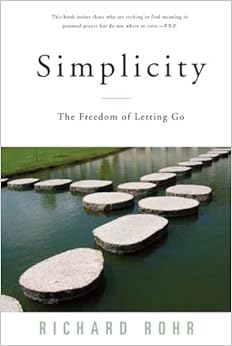
Simplicity: The Freedom of Letting Go by Richard Rohr


  • Paperback: 192 pages
  • Publisher: The Crossroad Publishing Company; Rev Upd Su edition (May 1, 2004)
  • Language: English
  • ISBN-10: 0824521153
  • ISBN-13: 978-0824521158


  • In this gem of a book, Richard Rohr introduces us to the vision of the Franciscan way of living, where joy, not dry theology, helps us build relationships and find peace in ourselves.


    Biography

    Fr. Richard Rohr is a globally recognized ecumenical teacher bearing witness to the universal awakening within Christian mysticism and the Perennial Tradition. He is a Franciscan priest of the New Mexico Province and founder of the Center for Action and Contemplation (www.cac.org) in Albuquerque, New Mexico. Fr. Richard's teaching is grounded in the Franciscan alternative orthodoxy--practices of contemplation and lived kenosis (self-emptying), expressing itself in radical compassion, particularly for the socially marginalized.

    Fr. Richard is author of numerous books, including Everything Belongs, Adam's Return, The Naked Now, Breathing Under Water, Falling Upward, and Immortal Diamond: The Search for Our True Self.

    CAC is home to the Rohr Institute where Fr. Richard is Academic Dean of the Living School for Action and Contemplation. Drawing upon Christianity's place within the Perennial Tradition, the mission of the Rohr Institute is to produce compassionate and powerfully learned individuals who will work for positive change in the world based on awareness of our common union with God and all beings. Learn more at www.cac.org.

    Thursday, November 14, 2013

    All that pesky societal meaningfulness and religious preachiness


    If you're a minority or a Christian fiction writer or BOTH, you have to be aware of the need to show minorityness or Christianness in your fiction.

    Some Christians say they want to write Christian fiction.

    Some Christians say they just want to write what they write and they don't need to bring Christ or some Christian doctrine into every story. They want to be free and different and unique. Trouble is when they write like other people, they really "write like other people." Seriously, a lot of writing by Christians "not writing as Christians" is as bland as any other non-specific fiction. This just makes me wonder what so many evngelical American Christians are reading that they are writing such stuff. I'm totally convinced that the types of movies you watch and the types of books you read contribute to the kind of stories one writes and the way one writes it.

    It's as if one is carving an axe and the axe one is carving is modelled after the axe one is using. <--not a="" about="" an="" ancient="" and="" are="" because="" being="" but="" chinese="" christian="" creativity="" don="" fictions="" from="" generalizations="" generalizing.="" generally="" have="" hey....i="" i="" it="" kind="" long="" m="" many="" metaphor="" my="" of="" on="" p="" poem="" read="" s="" some="" t="" that="" they="" thing.="" think="" true.="" unfair="" very="" writers="" yes="">
    Now about minority and Black writers.

    Black writers also kinda have the same issues...

    Some say they are just writers and they don't want folks to think of them as "Black writers."
    Others want to show the Black experience, even if we're outta space. Above all, there is that conscious desire to share one's heart. This often leads to stories that feel preachy and teacherly.

    So what's the problem?

    I think the problem is first
    1) the reading of the same general stuff. Christian folks who have read too many Christian books and are influenced by them, and Black fiction written by folks who have read way too much Black fiction.

    2) The consciousness of sharing one's experience. The consciousness of the idea to be shared is the problem. Somehow we have to let go of that consciousness. If we can do that, the story will feel more multicultural and less aimed at Black readers or white readers who are into Black sociology.

     I so want a Christian book that is truly totally deeply Christian and yet which doesn't feel normal and generic to me. But whether being totally Christian or being "I'm a Christian but that doesn't mean I'm a Christian writer" Christian fiction always feels so generic to me. Because of what Christians allow themselves to read and watch I think. The same American concerns, the same American fictional patterns, formulas, and ideas

    Not that I want Christian writers to go off the deep end and watch porn or atheist movies or flicks but I don't like reading a book which feels as if the author has seen only ten indie flicks in her life -- and those ten are the indie films everyone sees. And I don't want Black writers to stop reading Black fiction...I just want more multiculturalism and less ya know..."societal" meaning...and less fictional discussion of black oppression.


    Another favorite poem to reassess

    A few years ago I wrote a blog about the power of certain songs and poems to affect the soul. I think I wrote it on the song "I am a rock" and how because I wasn't careful, I made the song (and others like it) my inner vow.  Yes, songs like "I stand alone."

    These songs have power to affect the soul and certainly affected my life. So we really have to be careful about the songs/poems that healed us or our childhood selves.

    So today...I thought of one of my favorite Emily Dickinson poems.


    The soul selects her own society,
    Then shuts the door;
    On her divine majority
    Obtrude no more.
    Unmoved, she notes the chariot's pausing
    At her low gate;
    Unmoved, an emperor is kneeling
    Upon her mat.
    I've known her from an ample nation
    Choose one;
    Then close the valves of her attention
    Like stone.

    I realized to my deep grief and sorrow that the power described in this poem is not one I want to indulge in anymore. As a kid and a teen and as an adult in some churches I was rejected. Mostly racial issues. Or folks who thought I was just plain too uneducated or poor for them to befriend.

    I realized that in my fantasies (sexual or otherwise) there is a cruel power lingering, one I no longer which to have. I liked the idea of saying, "This is my friend and I will treat him/her gently and sweetly. But you are not my friend and so I will be impatient and cruel to you." I do this with a lot of people online and in the real world. It is a formof iniquity, i think. Because I will forgive my friends anything, ANYTHING, ANYTHING. But I will not easily forgive a non-friend even the smallest slight. It's an interesting kind of power to play the childhood kindergarten game of "He's my friend but you're not." But I want to grow in love and I don't want Holy Spirit to leaveme. It will mean risking being disliked by folks but I think I would rather not upset the Holy Spirit by having an unloving defensive heart that likes knowing it can be cruel to some people and not cruel to others.

    So there...another favorite poem has been analyzed and cast off with the old man that produced it.
    With Jesus helping me, I can do it. Thank you, Holy Spirit

    Saturday, November 09, 2013

    Beginner's Luck-- yet another phrase from the pit of hell

    Yes, now I'm on the rampage against "beginnger's luck" and "lucky in cards, unlucky in love."

    And once again it's about this:

    My son, attend to my words; incline thine ear unto my sayings.
    Let them not depart from thine eyes; keep them in the midst of thine heart.
    For they are life unto those that find them, and health to all their flesh.
    Keep thy heart with all diligence; for out of it are the issues of life. Proverbs 4:20-23


    Proverbs, dichus, etc all have the power to affect us and to create mental and spiritual strongholds. 
    So what does the concept of "Beginner's Luck" do?

    Well, let's say you've decided to do sweepstakesing. Let's say you win some wonderful stuff. Yep, this happened to me so I'm speaking from experience. When I first began sweepstakesing, I won $10K for a friend's wedding. (I'd entered his nme several times.) I won a box of 12 broderbund educational software one week and the next week won another box of educational software from another company. In a letter from one of the sponsors, i was told there were 600,000 entries. So, assuming both software contests had about the same amount of entries, I had won 2 out of 1,200,000 entries. I won other things as well, including roller blades for my son from E! Entertainment channel.

    Then someone says to you: "Oh, you're so lucky! it's beginner's luck." Suddenly I stopped winning. Your mind incorporates this idea -- very subtly, without you being aware of it-- and you start thinking there is a cut-off mark for luck. I'm telling you this really happens and it's an example of how strongholds affect our ability to receive from God or to be blessed by the spiritual laws of the universe. I used to be weirdly lucky when it came to knowing which horse would win in  race. It was just uncanny. Then someone said to me, "Lucky in cards, unlucky in love." And I suppose some part of me believed that, and because I didn't want to be unlucky inlove....voila, the ability left.

    I had not guarded my heart against that particular proverb. The world brainwashes us. That's why we have to keep in God's word to have our minds washed and cleaned up by God's view of reality. 

    But it also reaches past the idea of luck. It also has to do with our ability to receive answers to prayers. We develop this quota mindset and start thinking we have received "enough good" and maybe heaven's gonna shut down on us.  Without realizing it, we develop this subconcious belief in a God who has limits. The word of God only works in a heart that is ready for it. We have to break up our fallow ground. Folks who have finally managed to get past the false truth of "earning" God's kindness, but who still are believing that God's kindness have a quota, are not able to receive, wish or imagine certain blessings.

    When my husband's sister was dying, his father prayed this prayer to God: "God, you know I've never asked you for anything unimportant. But I'm asking you now. And if you hear this prayer I will never ask again."

    Now, whether she would have been healed or not, there really is something very unBiblical and very wordly about tht prayer. We are all taught that God the big CEO in the sky helps only those who helps themselves and only cares for important things. Yet the Bible says, "Cast all your cares upon Him for He careth for you." The Scripture doesn't say, "Cast all your important care, cast all your care after you have carried them appropriately long enough, cast all your tried and true valid care after you have tried to help yourself."

    I remember once i was sooo soo thirsty. I'd gone for a long walk without drinking any water. So I sid to God, "I'm so thirsty. I want some coconut water.But i have no money. Could you drop  dollar for me on the road so i can go to the deli two blocks down the road to buy some?" After I sked this, i felt a joy and a total assurance that i would get the dollar. I felt i should walk a block out of my way along a certain road. I went down that road and kept looking on the ground. Bingo: a dollar bill was on the ground. Someone had dropped it. I giggled wildly and went to get the coconut water.

    The next day i also forgot to drink some water and was walking again. But try as i could I kept thinking, "God won't let me find money again. Not again. He thinks I should know better than to repeat the same mistake again. And even if he isn't mad at me for making the same mistake again, He doesn't do miracles twice in a row." Of course none of this is Biblicl. But my objections are stuff one picks up in the air, crappy seeds put in the ground that stand up as strongholds in our mind against God's extreme kindness and goodness.  

    So hubby and i were lying in bed pondering and discussing the many proverbs, sayings, platitudes that we have allowed to affect our hearts...and thus affect the spiritual ground God's seed is planted in. 

    Leaving you with this:

    Hear ye therefore the parable of the sower. When any one heareth the word of the kingdom, and understandeth it not, then cometh the wicked one, and catcheth away that which was sown in his heart. This is he which received seed by the way side. But he that received the seed into stony places, the same is he that heareth the word, and anon with joy receiveth it; Yet hath he not root in himself, but dureth for a while: for when tribulation or persecution ariseth because of the word, by and by he is offended. He also that received seed among the thorns is he that heareth the word; and the care of this world, and the deceitfulness of riches, choke the word, and he becometh unfruitful. But he that received seed into the good ground is he that heareth the word, and understandeth it; which also beareth fruit, and bringeth forth, some an hundredfold, some sixty, some thirty. Matthew 13: 18-23


    Tuesday, November 05, 2013

    Pondering: Fantasy, daydreaming, hope

    Hope imagines. But it imagines things it believes is good for itself. Based on one's knowledge of Scripture or one's own ethics, one's hope can be morally questionable -- but even so it's daydreams are geared toward some wished-for situation.

    Despair imagines. But it imagines and meditates on what it fears. Based on one's knowledge and trust (or distrust) of Scripture, the images one meditates on in one's despair is either seen as the only possible future one could dream of (when one finds one's self in a bad situation.)

    There is imagining impossibilities that may happen, and imagining improbabilities, and imagining miracles.

    Both imagining impossibilities and imagining improbabilities have to do with attempts to heal. But imagining impossibilites involve back-tracking -- daydreaming about the past, woulda-coulda-shoulda-ing. In those daydreams, we often are attempting to heal our past soul wounds and so it's vain imaginings.  We are often not our own age, and yet we somehow are in the current era/year...which is always a bad sign. So daydreaming of being our twenty year old selves in 2013 with some famous young hottie.....nah, not gonna happen.

    Imagining improbabilities is a step higher toward true hope. We are at least in the present, we are our own age, we are doing wonderful things or engaging with wonderful people. But the things, the people are slightly improbable...and again there is a need to heal our wounded soul. Thus we may daydream about being our real age but we put ourselves in such improbable situations. If our souls and spirits are being healed by imagining ourselves with some rich,powerful, famous person....well chances are this is not a true hope.

    Imagining miracles. Well, this is true hope. It is setting the mind on the thing desired, imagining a good outcome based on a promise of God. This is the hardest daydream to enter because we have to know Scripture, we have to imagine Jesus or some holy Biblical person doing the miracle, and then we have to imagine God in us (the hope of glory) or some other Christian doing the miracle. Or we can just imagine a sovereign move of God without any human agency.

    This kind of daydreaming is also difficult because when we reach a point in life where we need a miracle, our minds have often already become washed with negative images. So we're battling the vain negtive images the doctors, memory, time or habit have put in our minds and hearts...while at the same time trying to trust God's word and the images the Scripture wants to put into our minds. Plus, our daydreaming habits have usually not been creative or hopeful. So it's difficult to picture good things happening.

    True hope is not vain or depressing or impossible imaginations; it is hope of salvation. I'm not saying our thoughts create our reality. Because God is able to give us more than we are able to ask or wish. I'm saying that we should at least keep tabs on our wishing. We should at least put as much conscious effort into imagining what life will be like when (not what life might be like if) our prayers come true. We should at least consciously imagine the looked-for end with the same gusto that we put into a sexual fantasy. We should walk around in our future hope knowing every nook and corner of it.

    So there I was...realizing I am age 54. This means ...many of the daydreams and fantasies I have been indulging in for the past 34 years must now be put to rest. There is really no way that many of these fantasies will come true. Rich Korean young hottie will not arrive and bring my younger self or my current self happiness. But really, these daydreams are my second homes. What to do with them? Make stories out of them. I know those worlds so well. And in letting go of them and training my mind to lose past them...I can have my cake and eat it too. My mind will let them go but they will forever be engraved in story form.

    Will see how it works. Sad...but some dreams have to be let go. 

    Blog Archive

    Popular Posts